
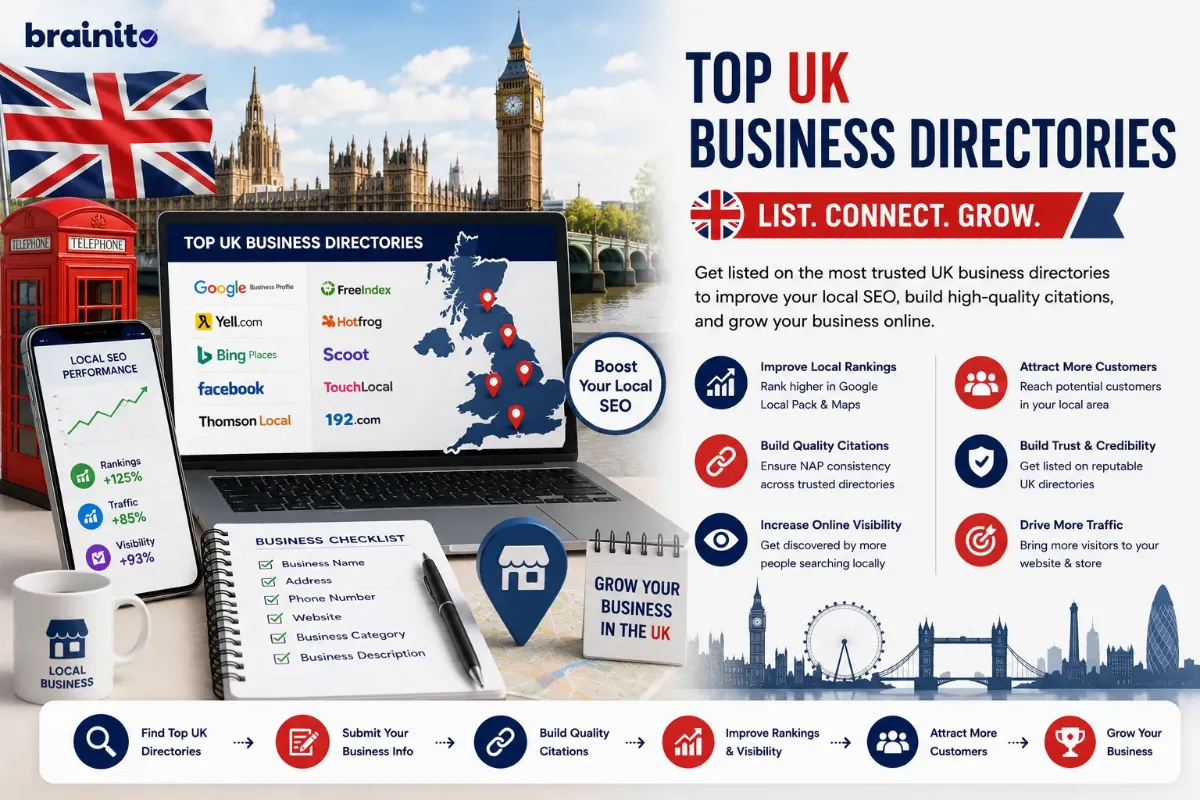
Discover the top UK business directories for 2026 and learn how to build accurate citations that lift local rankings, traffic, and customer trust.
Why UK Business Directories Still Matter in 2026
Directory listings are one of the oldest tactics in local marketing, and they are still quietly doing heavy lifting in 2026. When someone in Manchester searches for a plumber or a Bristol shopper looks for a coffee roaster, search engines lean on directory data to decide who is real, who is nearby, and who deserves to rank. A consistent presence across trusted UK directories signals legitimacy to both algorithms and people.
The value is not just rankings. Many of these platforms carry their own audiences who browse, compare, and book without ever touching a traditional search results page. A well-built listing becomes a second storefront that works while you sleep.
The catch is that not all directories are equal. Spraying your details across hundreds of low-quality sites does nothing except create cleanup work later. The goal is a focused set of authoritative listings with identical information everywhere. If you want a fast read on where your current citations stand, our free marketing audit reviews your site across 77 factors and flags local visibility gaps before they cost you customers.
What Makes a Directory Worth Your Time
Before listing anywhere, weigh each directory against a few practical filters. Quantity has never been the goal. A handful of strong profiles will always beat a scattergun of forgotten ones.
Authority and trust
Established directories pass more credibility to your business. Look at how long a site has existed, whether it ranks for local terms itself, and whether real users actually visit it. A high domain authority listing carries weight that a thin, ad-stuffed page never will.
Audience and review features
The best directories bring their own traffic and let customers leave reviews. Reviews build social proof and feed the trust signals that influence local rankings. A directory where buyers actively research and compare is worth far more than a silent listing nobody sees.
Relevance to your market
Industry-specific and region-specific directories often convert better than broad ones because the people browsing them already have intent. A local trade directory can outperform a giant generic platform for a niche service business.
The Essential General UK Directories
Start with the platforms that nearly every UK business should claim. These form the backbone of your citation profile and tend to carry the most authority and reach.
Google Business Profile
This is the single most important listing for any local business. It powers your presence in Google Maps, the local pack, and branded searches. Complete every field, add photos, post updates, and respond to reviews regularly. If you want a focused check of your profile health, our GMB audit tool highlights exactly what is missing or underused.
Bing Places
Often overlooked, Bing still drives meaningful UK traffic, especially among desktop and Microsoft Edge users. Claiming Bing Places takes minutes and broadens your reach beyond Google alone.
Yelp UK
Yelp remains a destination for diners, tradespeople, and service seekers who want to read genuine reviews before committing. A complete, well-reviewed Yelp profile can quietly become a steady referral source.
Foursquare
Foursquare data feeds maps, apps, and recommendation engines across the web. A single accurate Foursquare listing can ripple your details out to dozens of downstream services.
UK-Focused Directories Worth Claiming
Beyond the global platforms, several home-grown UK directories carry strong local authority and audiences who specifically search within Britain.
Thomson Local
A long-standing UK directory with maps, route planning, and category browsing. It is well indexed and trusted by users who prefer a familiar British resource.
UK Small Business Directory
A curated, verification-based directory that favours quality over volume. Because listings are reviewed, the trust signal it passes tends to be stronger than open free-for-all sites.
Hotfrog and Express Business Directory
Both offer free listings and have built sizeable user bases over the years. They are easy wins for expanding your citation footprint without spending a penny.
Niche and regional listings
Do not ignore the smaller players. Local chamber of commerce sites, county business directories, and trade-specific platforms often deliver warm, ready-to-buy traffic. If you are building a structured plan for which listings to pursue first, our DIY marketing plan walks you through prioritising local channels step by step.
How to Build Citations That Actually Help
Getting listed is the easy part. Getting listed correctly is what moves the needle. Search engines reward consistency and quietly penalise confusion.
Keep your NAP identical everywhere
Your business Name, Address, and Phone number must match exactly across every directory, right down to abbreviations and formatting. Mismatched details split your trust signals and can suppress local rankings. Audit your existing listings and fix any inconsistencies first.
Fill every field and add media
Complete listings outperform sparse ones. Add your hours, services, categories, a compelling description, and real photos. The richer the profile, the more reasons a browser has to choose you.
Earn and respond to reviews
Reviews are the lifeblood of directory performance. Ask happy customers to leave honest feedback and reply to every review, positive or negative. Active engagement signals a living, trustworthy business.
Layer in related marketing
Directory listings work best alongside the rest of your local strategy. Pairing them with strong on-page content and a clear plan multiplies the impact. When you are ready to act on the gaps, the free marketing audit returns a prioritised action plan so you fix the highest-impact issues first instead of guessing.
Common Mistakes to Avoid
Even well-meaning businesses sabotage their directory efforts with avoidable errors. Watch for these traps as you build out your listings.
Chasing volume over quality
Mass-submitting to hundreds of obscure directories creates duplicate and low-value citations that can do more harm than good. Focus on a curated set of reputable platforms instead.
Setting and forgetting
Listings drift out of date as you move, change hours, or update services. Stale information frustrates customers and erodes trust. Review your profiles at least twice a year.
Going it alone when help pays off
Maintaining accurate citations across dozens of platforms is genuinely time-consuming. If your team is stretched, it can be worth bringing in support. You can hire a marketer to manage listings, reviews, and the wider local strategy so nothing slips through the cracks.
Frequently Asked Questions
How many UK business directories should I list on?
There is no magic number, but most local businesses see strong results from a focused set of 10 to 20 high-authority, relevant directories with consistent details, rather than hundreds of low-quality ones. Start with Google Business Profile, Bing Places, Yelp UK, and a few trusted UK-specific sites, then expand into niche and regional listings that match your market.
Do directory listings really improve local SEO?
Yes, when done correctly. Consistent citations across reputable directories reinforce your business legitimacy and location signals, which support local pack and Maps rankings. The effect compounds when paired with genuine reviews, complete profiles, and a wider local marketing strategy. Running a free marketing audit is a quick way to see where your citations and overall local presence stand today.
How do I keep my listings consistent across so many sites?
Document your exact Name, Address, and Phone number in one master reference and use it every time you create or update a listing. Schedule a recurring review to catch outdated details, and consider tooling or outside help if the volume becomes hard to manage manually.