
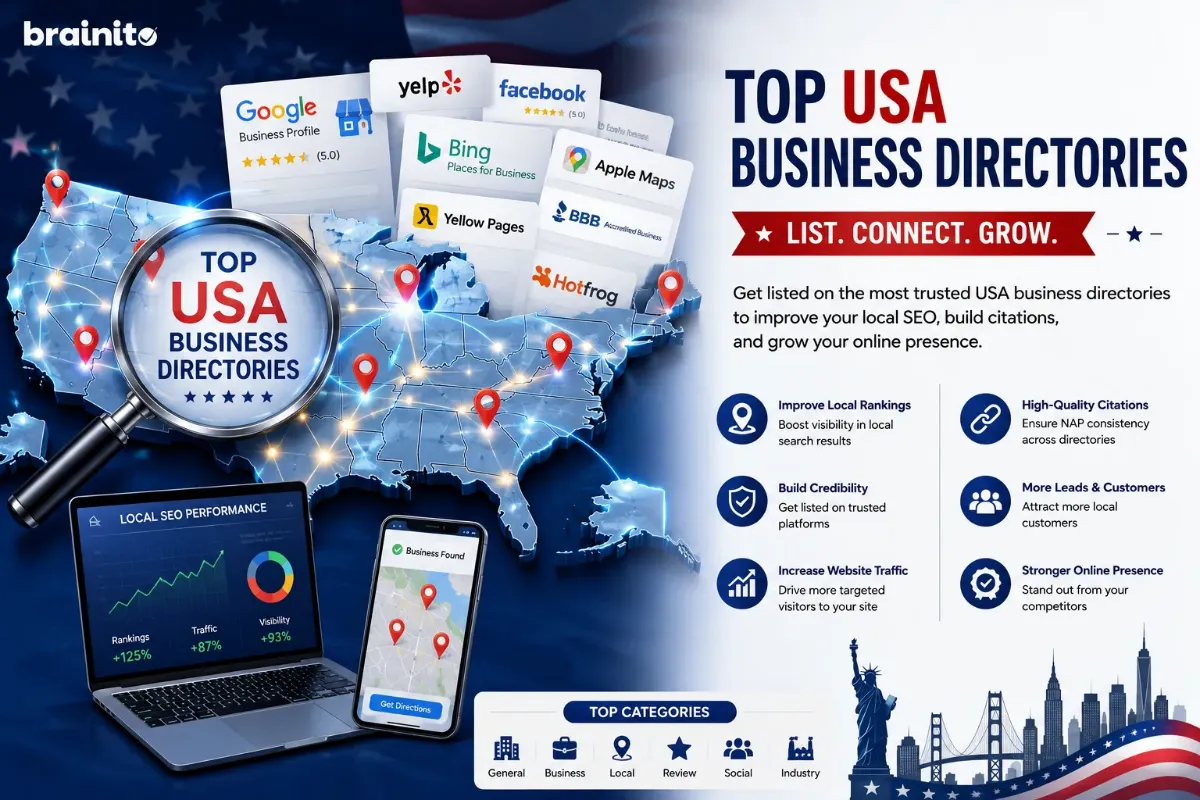
Discover the top USA business directories for 2026 to boost local SEO, build citations, and get found by customers searching online for your services.
Why Business Directories Still Matter in 2026
It is tempting to think directories are a relic from the phone-book era, but the data says otherwise. The overwhelming majority of people research local companies online before they ever pick up the phone or walk through a door. When your business appears on trusted directories with accurate, consistent details, you show up in more of those moments of intent.
Directories do three jobs at once. They put your name in front of buyers who are actively searching, they feed structured data to search engines, and they create the citations that local SEO depends on. A citation is simply a mention of your business name, address, and phone number (often abbreviated NAP) on another website. The more consistent citations you have, the more confident Google becomes that your business is real, located where you say it is, and worth ranking.
The compounding effect of consistency
One listing rarely moves the needle. Fifteen consistent listings across reputable directories build a foundation that lifts your visibility everywhere. The trick is consistency: the same name, the same suite number, the same phone format on every platform. Even small mismatches confuse search engines and dilute your authority. Before you chase new listings, it is worth running a free marketing audit to see where your current citations stand and which gaps to fix first.
How to Choose the Right Directories for Your Business
Not every directory deserves your time. Listing your business on hundreds of low-quality sites can actually hurt you, because spammy directories pass weak or even harmful signals. Focus on relevance and reputation instead of raw volume.
Three questions to ask before you list
First, does the directory serve your industry or location? A national service directory is great for a plumber, while a niche industrial directory suits a manufacturer. Second, does the directory have real traffic and authority? A quick search for the directory name plus reviews tells you a lot. Third, does it let you control your listing details, add photos, and respond to reviews? Directories that offer ownership and engagement deliver far more value than static listings.
If you are mapping out your channels from scratch, our DIY marketing plan walks through how directory listings fit alongside content, social, and paid efforts so you are not duplicating effort or missing obvious wins.
The Top USA Business Directories Worth Your Time
Below are directories that consistently deliver visibility for US businesses in 2026. Most offer a free basic listing with optional paid upgrades, so you can start at zero cost and expand where it pays off.
- Google Business Profile: The single most important listing for any local business. It powers Maps, the local pack, and knowledge panels. If you do nothing else, claim and optimize this one.
- Bing Places: Bing still drives meaningful traffic and feeds several AI assistants. Importing your Google profile takes minutes.
- Yelp: A review powerhouse, especially for restaurants, home services, and retail. Reviews here often surface directly in search results.
- Manta: A long-standing small-business directory with educational resources alongside listings, useful for B2B visibility.
- Yext: Less a single directory and more a management layer that syncs your details across dozens of platforms and voice assistants at once.
- Kompass: A global B2B directory with millions of company profiles, ideal for manufacturers and suppliers seeking international reach.
- Cylex and Tupalo: Community-driven directories with free and premium tiers that add review breadth and extra citations.
- DexKnows and EZLocal: Local-focused directories that integrate with major search engines and strengthen your citation profile.
Industry-specific platforms matter too: Angi for home services, Healthgrades for medical providers, Avvo for attorneys, and TripAdvisor for hospitality. A handful of relevant niche listings often outperform a dozen generic ones.
Optimizing Each Listing for Maximum Visibility
Claiming a listing is only the start. An optimized profile converts far better than a bare-bones one, and it sends richer signals to search engines.
Complete every field
Fill in your hours, categories, service areas, and a keyword-aware business description. Add high-quality photos, because listings with images earn more clicks and calls. Choose the most specific primary category available rather than a broad one, then add secondary categories where they apply.
Keep NAP identical everywhere
Decide on one canonical version of your name, address, and phone number and use it without variation. "Street" versus "St." or two different phone numbers across listings is enough to weaken your local authority. To verify your foundations are solid before you scale, a free marketing audit scores your site and listings across 77 factors and hands back a prioritized action plan, so you fix the highest-impact issues first.
Earn and respond to reviews
Reviews are both a ranking factor and a trust signal. Ask happy customers to leave honest feedback, and respond to every review, positive or negative, with a professional tone. Consistent engagement signals an active, legitimate business.
Common Directory Mistakes to Avoid
Even well-intentioned business owners undermine their efforts with a few avoidable errors. Watch for these.
Inconsistent information: The most common and damaging mistake. Audit every listing and align the details. Duplicate listings: Multiple unclaimed profiles for the same location split your reviews and confuse rankings, so claim or merge them. Set-and-forget syndrome: Hours change, you move, you add services. Outdated listings frustrate customers and cost you business. Chasing quantity over quality: Resist mass-submission services that blast your details across hundreds of junk directories, which can trigger spam signals.
If managing all of this feels like a part-time job on top of running your business, it often makes sense to bring in help. You can hire a marketer to own your local SEO and keep every citation accurate, or explore transparent pricing to see what hands-on support costs.
Turning Directory Listings Into a Growth Engine
Directories are a foundation, not a finish line. Once your citations are clean and consistent, the next layer is content that gives those listings something to point to: helpful pages, location-specific articles, and answers to the questions your customers actually search for.
That is where directory work compounds with the rest of your marketing. Strong listings feed traffic to your site, and strong content keeps that traffic engaged and converting. If you want to accelerate the content side, tools like our blog content generator and content calendar generator help you publish consistently without burning out. For more local SEO playbooks and step-by-step guides, browse the Brainito blog.
Frequently Asked Questions
Are free business directory listings worth it, or should I pay?
Free listings are absolutely worth claiming first, especially Google Business Profile, Bing Places, and Yelp. They build citations and visibility at zero cost. Paid upgrades make sense once you know a directory drives real traffic for your industry, or when premium features like enhanced profiles and lead generation clearly pay for themselves. Start free, measure results, then upgrade selectively.
How many business directories should I list my business in?
Quality matters more than quantity. For most local businesses, 15 to 30 relevant, reputable directories cover the major search engines, review platforms, and industry-specific sites that actually influence rankings. Beyond that, returns diminish quickly, and listing on low-quality directories can do more harm than good. Prioritize the platforms your customers and search engines trust most.
How do I keep all my directory listings consistent?
Document one canonical version of your business name, address, and phone number, then audit each listing against it. Use a management tool like Yext to push updates across platforms at once, or schedule a quarterly review to catch changes. A free marketing audit flags inconsistencies and gives you a prioritized list, so you spend time only where it moves the needle.