
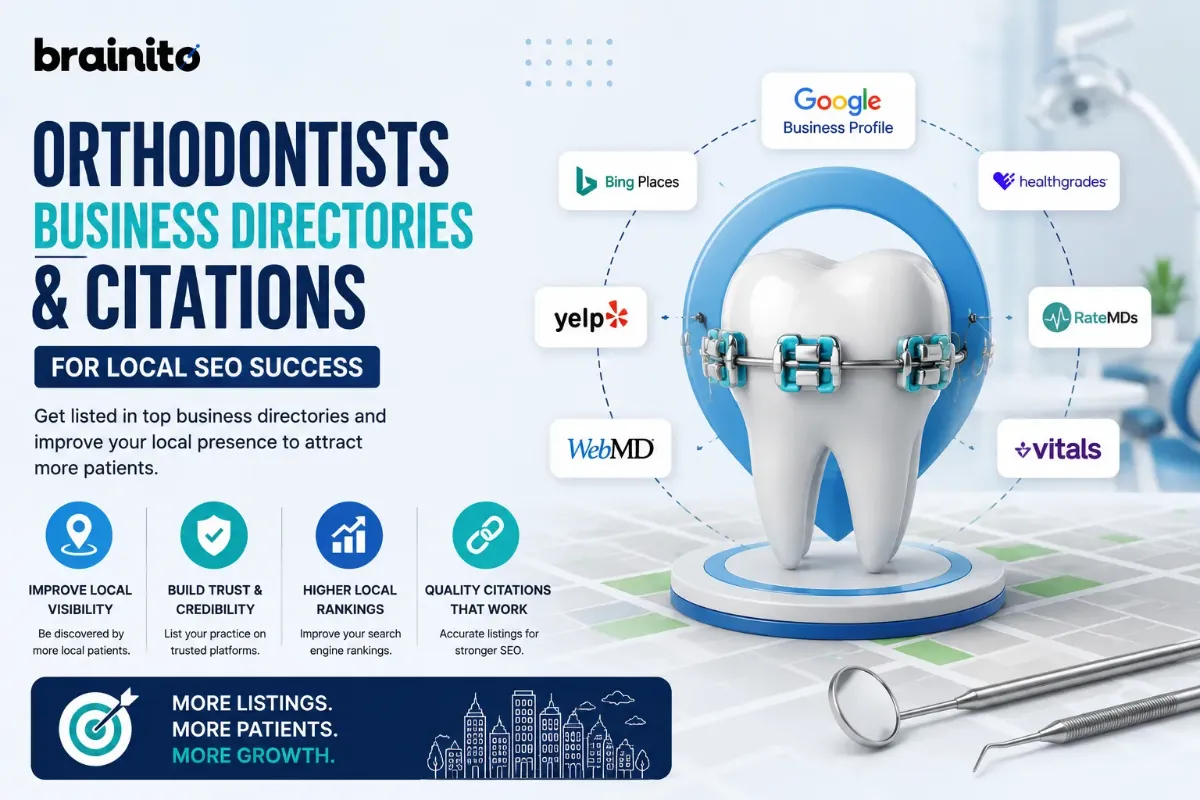
Build orthodontist local SEO with consistent citations and high-authority dental directories. Learn which listings drive patients and rankings in 2026.
Why Citations Still Matter for Orthodontists
When someone searches "Invisalign near me" or "braces for kids," Google has to decide which orthodontic practice to surface first. A big part of that decision rests on something most practices ignore: business citations. A citation is any online mention of your practice name, address, and phone number (your NAP), whether it lives on a dental directory, a review site, or a local business listing.
Citations act as trust signals. When dozens of reputable sources confirm the same details about your practice, Google grows more confident that you are a real, established business in your service area. That confidence translates into higher local rankings, more visibility in the Google Map Pack, and ultimately more booked consultations.
For orthodontists specifically, the stakes are high. Treatment value is significant, the buying decision is local, and competition in most metro areas is fierce. Clear aligners alone have reshaped the market, with Invisalign holding the lion's share of clear aligner volume, so practices that want to capture demand need to show up the moment a prospective patient starts searching. Citations are one of the most cost-effective ways to earn that visibility.
How Directory Listings Influence Local Rankings
Search engines reward orthodontic practices that appear consistently across the web. A directory listing does three things at once: it builds a credible backlink, it reinforces your NAP data, and it creates an additional discovery path for patients who browse directories instead of searching Google directly.
The discoverability advantage
Your website is only one entry point. Many patients, especially parents researching treatment for their children, start on dental directories or insurance provider lists. A listing on those platforms puts your practice in front of high-intent searchers who may never have found your site through organic results alone.
The authority advantage
Not all directories carry equal weight. A listing on a high Domain Authority site like the American Dental Association passes far more SEO value than a low-quality aggregator. The best strategy blends a handful of top-tier dental directories with broader local platforms so you earn both authority and reach. If you want a clear picture of where your current listings stand, a free marketing audit scores your site across 77 ranking factors and flags citation gaps you can fix this week.
The Directories Every Orthodontic Practice Should Claim
Start with the platforms that combine high authority, patient traffic, and trust. You do not need every directory in existence; you need the right ones, claimed correctly and kept current.
Dental and orthodontic directories
- American Dental Association (ADA) directory carries some of the strongest authority in the dental space and signals legitimacy to both patients and search engines.
- 1-800-DENTIST and similar patient-matching platforms drive qualified referral traffic on top of their SEO value.
- American Association of Orthodontists (AAO) member listings are specialty-specific and highly relevant for ranking on orthodontic search terms.
General local and review platforms
- Google Business Profile is non-negotiable. It powers the Map Pack and is the single most important local listing you own.
- Yelp, Healthgrades, and Zocdoc blend reviews with directory authority and convert browsers into bookings.
- Bing Places, Apple Business Connect, and Facebook round out coverage across the platforms patients actually use.
Once these foundations are claimed, expand into regional chambers of commerce and niche health directories to deepen your local footprint.
NAP Consistency: The Detail That Quietly Sinks Rankings
The fastest way to undermine a citation strategy is inconsistency. If one directory lists your practice as "Suite 200" and another says "Ste. 2," or if an old phone number lingers on a profile you forgot about, search engines lose confidence in your data. Mixed signals can suppress rankings even when you have dozens of listings.
Decide on one canonical version of your practice name, address, and phone number, then enforce it everywhere. Audit existing listings for duplicates and outdated entries, which are common after a practice moves, rebrands, or merges. Cleaning up conflicting citations often produces faster ranking gains than adding new ones.
This is exactly the kind of issue a structured review surfaces quickly. Running a free marketing audit gives you a prioritized action plan so you tackle the highest-impact NAP fixes first instead of guessing. If your team is short on bandwidth, you can also hire a marketer to handle the cleanup and ongoing monitoring.
Building a Repeatable Citation and Content Workflow
Citations work best as part of a broader local SEO system, not a one-time project. The practices that dominate their markets pair clean listings with consistent content and reviews.
Pair citations with local content
Directory listings tell Google where you are; content tells Google what you do. Publish location-aware pages and posts answering the questions patients actually ask, such as treatment timelines, financing, and what to expect with aligners. A simple editorial rhythm keeps your site fresh and reinforces relevance. Tools like a content calendar generator and a blog content generator make it realistic to keep that pipeline full even with a small team.
Make reviews part of the routine
Reviews on directory profiles influence both rankings and patient trust. Build a habit of inviting happy patients to review you on Google and Healthgrades right after treatment milestones.
Plan before you publish
If you want a structured roadmap for the whole effort, a DIY marketing plan helps you sequence citations, content, and reviews into a quarter-by-quarter plan. For practices ready to scale, reviewing your pricing options for done-for-you support can save months of trial and error.
Measuring Whether Your Citations Are Working
Effort without measurement leads to wasted spend. Track a handful of signals to confirm your citation strategy is moving the needle.
Watch your visibility in the Google Map Pack for core terms like "orthodontist" and "Invisalign" plus your city. Monitor referral traffic from directories in your analytics to see which listings actually send patients. Keep an eye on your Google Business Profile insights for calls, direction requests, and website clicks, since these map directly to booked consultations.
If rankings stall despite a healthy set of listings, the bottleneck is usually elsewhere: thin content, slow page speed, or weak backlinks. Reading through related guides on the Brainito blog can help you diagnose the next lever to pull, and a fresh free marketing audit will tell you precisely where your practice is losing ground.
Frequently Asked Questions
How many directories does an orthodontic practice really need?
Quality beats quantity. Start with the essential platforms (Google Business Profile, the ADA and AAO listings, Healthgrades, Zocdoc, Yelp, Bing Places, and Apple Business Connect), make sure every entry is accurate, then expand into regional and niche directories. A focused set of 15 to 25 well-maintained citations usually outperforms hundreds of inconsistent ones.
Are paid directory listings worth it for orthodontists?
Sometimes. Paid placements on high-authority dental directories or patient-matching platforms can deliver both SEO value and direct referrals, but only if the directory has real traffic and authority. Claim the strong free listings first, then evaluate paid options based on the referral patients and rankings they realistically drive.
How quickly will citations improve my local rankings?
Cleaning up inconsistent NAP data can produce noticeable gains within a few weeks, while building new citations and earning trust typically shows results over two to three months. Pairing citations with consistent content and reviews accelerates the timeline. A free marketing audit can help you prioritize the fixes most likely to move rankings fastest.