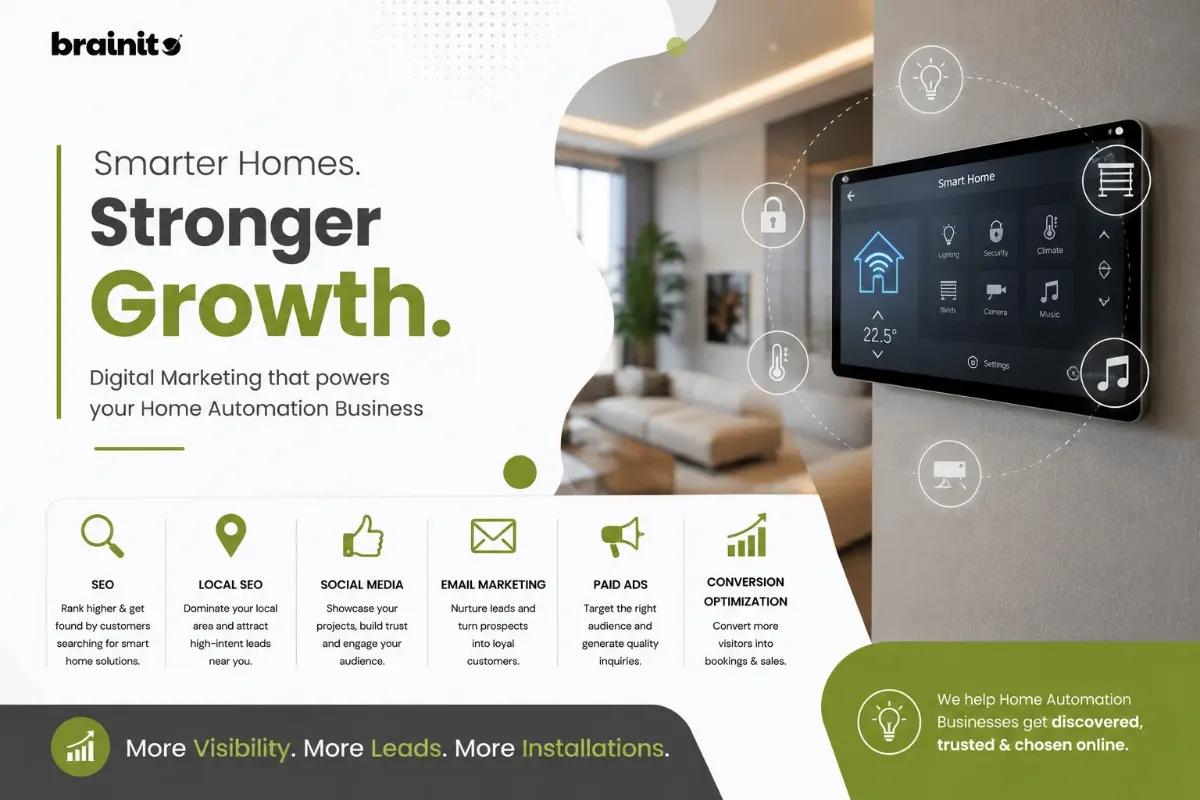
Home automation business marketing that books installs: target the right buyers, show the system working, win local search, build partners and follow up well.
Why Home Automation Marketing Needs Its Own Playbook
Selling a smart home is not like selling a single gadget. You are asking a homeowner to rewire how their lights, security, climate, and entertainment all talk to each other, and to trust one company to make it all work together. That is a high-consideration purchase with a long research window, which means generic advertising rarely closes the deal on its own.
The smart-home market keeps growing, and that growth attracts crowds of installers, integrators, and DIY brands, so the businesses that win are the ones that market with clarity rather than noise. The strategies below are built for that reality: long buying cycles, cautious buyers, and a need to prove value before money changes hands.
If you want a fast read on where your current marketing leaks leads, start with a free marketing audit. It scores your site across 77 factors and hands back a prioritized action plan, so you spend effort on the gaps that actually cost you installs.
Home Automation Brand Strategy: Know Who You Sell To
Home automation buyers are not one audience. A new-construction homeowner wants whole-home integration baked into the build. A busy professional wants convenience and a security upgrade. A landlord wants energy savings and remote access across units. Each of these people responds to different language, different proof, and different price framing.
Build buyer segments before you build campaigns
Map two or three core segments and write down their real pain: the late-night worry about an unlocked door, the frustration of juggling five apps, the dread of a surprise energy bill. When your messaging names the problem the buyer already feels, your ads stop competing on price and start competing on relevance.
Validate with real conversations
Before scaling spend, talk to actual prospects and recent customers. Even a handful of structured interviews will surface the objections and trigger moments that shape better copy. If you want that turned into a repeatable plan you can execute yourself, our DIY marketing plan walks through segmentation and positioning step by step.
Lead With Demonstration, Not Description
Nobody buys a smart home from a spec sheet. They buy the feeling of saying "lock the doors" and watching it happen. Your marketing has to recreate that moment before the sale, which makes visual and experiential content your strongest asset.
Use video to show the experience
Short explainer and walkthrough videos let a prospect picture the system in their own home. Show a real scene at dusk: lights dimming, blinds closing, the security system arming, all from one tap. Publish these on YouTube and embed them on your service pages so they double as content and as conversion proof.
Offer a no-pressure demo or consultation
A free in-home consultation or showroom demo removes the biggest barrier in this category, which is uncertainty. Once a homeowner experiences the convenience firsthand, price becomes a detail rather than a wall. Make booking that demo the single clearest call to action across your site and ads.
Build Trust With Proof and Local Authority
High-ticket purchases run on trust. The home automation companies that grow steadily are the ones that look credible the moment a stranger lands on their site, and credibility is something you can engineer.
Turn finished jobs into case studies
Document your best installations with before-and-after photos, the homeowner's goal, and the outcome they got. A handful of detailed case studies will outperform a wall of star ratings, because they let a prospect see themselves in a similar situation. Reviews still matter, so make collecting them a routine part of project closeout.
Win local search and your Google profile
Most of your buyers search locally before they ever call. Optimize for terms like "smart home installer near me" and keep your Google Business Profile complete, photo-rich, and stocked with recent reviews. A quick GMB audit will show where your profile is losing visibility to competitors. For the keyword side, our keyword research tool helps you find the exact phrases worth ranking for.
Smart Home Integrator Marketing: Paid Ads and Partners
Organic trust-building is the foundation, but paid and partnership channels are what fill the pipeline while your content compounds. The trick is to match each channel to where the buyer sits in their journey.
Targeted paid ads and retargeting
Facebook and Google ads let you reach homeowners by location, home value, and interest signals. Because this is a long-consideration purchase, retargeting is non-negotiable: most prospects will not convert on the first visit, so keep your brand and your demo offer in front of them. Tighten your ad structure with our Google ad structure generator, and sharpen your social creative using the Facebook ad copy generator.
Partner with the people already in the home
Interior designers, custom builders, electricians, and real estate agents are talking to your future customers every day. A referral relationship with these professionals delivers warm, pre-qualified leads at a fraction of paid-ad cost. Offer them a simple commission or co-marketing arrangement and make it easy for them to recommend you.
Show up where buyers gather
Home and tech expos, builder showcases, and local community events let prospects experience your systems in person. Pair an interactive booth with a lead magnet, such as a web-based cost calculator, so every conversation becomes a tracked lead rather than a forgotten handshake.
Nurture Leads Until They Are Ready to Buy
Because the decision window is long, the business that stays helpful and present usually wins the install. That is the entire job of a nurture system: stay useful while the buyer makes up their mind.
Build an email funnel around the buying journey
Capture leads with a useful asset, a cost estimator or a smart-home planning guide, then send a sequence that answers questions, shares case studies, and gently moves toward booking a consultation. Strong subject lines decide whether any of it gets read, so test them with our email subject line generator.
Keep a steady content engine running
Buying guides, comparison posts, and "is a smart home worth it" articles pull in researchers early and position you as the expert by the time they are ready to spend. A planned calendar keeps this consistent rather than sporadic; build one with our content calendar generator. If you would rather hand the whole demand-generation effort to a specialist, you can hire a marketer to run it for you.
Home Automation Business Marketing by Channel
Home automation is a considered purchase: buyers want to see it working, trust the installer and understand the total cost. Each channel should answer one of those.
Search for specific systems
People search for what they want done: "smart lighting installation", "whole-home audio", "home cinema installer", "smart home security [city]". Build a page for each, with project photos, the platforms you install and typical project scope.
Video that shows the result
Short videos of a scene changing, blinds closing or a system being controlled from a phone sell better than any description. Post them on your site, YouTube and Instagram, and use them in follow-up emails.
Partners who meet buyers first
Builders, architects, interior designers, electricians and AV retailers meet your customers before you do. A simple referral arrangement with a few of them can become your best lead source.
Local trust
Keep a complete Google Business Profile with project photos and reviews, and consistent listings on trade directories. For the wider picture, see AI marketing for contractors.
A 90-Day Marketing Plan for a Home Automation Business
Most home automation companies do not need more marketing ideas; they need the right few done in the right order. Here is a 90-day sequence you can follow without an agency.
Days 1 to 14: audit and focus
Run a free marketing audit, decide which two or three system types you most want to sell, and rewrite your homepage around them.
Days 15 to 45: build proof
Create a page and a short video for each focus system using real projects, and ask past clients for reviews and permission to use photos.
Days 46 to 75: partner outreach
Approach five builders, designers or electricians with a referral offer and a short presentation of finished projects.
Days 76 to 90: nurture and convert
Send every enquiry a follow-up sequence with project videos and a clear next step, such as a home survey or a showroom visit.
Home Automation Marketing Ideas You Can Start This Month
If you want quick wins for your smart home business marketing, pick three of these ideas and finish them before you start more. Each one fits a small team.
- Film a short evening scene in a finished project: lights dim, blinds close, the alarm arms. Pin it to your website, Google Business Profile and Instagram.
- Turn your showroom, or a willing past client's home, into a bookable demo evening.
- Build one page for each system you install and each area you serve, with real project photos.
- Write a plain guide to what drives the cost of a smart home project, such as room count, wiring and the systems chosen.
- Give builders, designers and electricians a one-page referral sheet with your finished projects and contact details.
- Ask every client at handover for a review and permission to use photos.
- Offer a support or maintenance plan so one-off installs become recurring work.
- Send past clients a yearly check-up offer for updates and new devices.
- Add a short project form that asks which rooms, which systems and what timeline, so enquiries arrive qualified.
What to avoid
Do not lead with brand names and spec lists, because buyers want outcomes. Do not send ads to your homepage; send them to the page for that system. And do not let enquiries wait. In a long buying cycle, the installer who replies first and follows up with real project examples is often the one who books the survey. To see where you appear in local results today, check with Brainito's Google Maps ranking checker.
Frequently Asked Questions
How do I market a home automation business?
Build a page and video for each system you install, collect reviews and project photos, work with builders, designers and electricians who meet buyers first, and follow up enquiries with real project examples.
Where do home automation leads come from?
Mostly from local search for specific systems, referrals from builders, architects and designers, and past clients. Paid search works best for high-intent searches such as installation in your city.
What is the most effective first marketing move for a new home automation business?
Start by nailing local search and on-site trust signals before you spend heavily on ads. A complete Google Business Profile, two or three strong case studies, and a clear demo offer will convert the traffic you already get. Run a free marketing audit first so you fix the highest-impact gaps before investing in paid channels.
How do I market a high-priced smart-home system without competing only on price?
Lead with the experience and the outcome, not the spec list. Use video demos, in-home consultations, and detailed case studies so buyers feel the convenience and safety before they ever see a quote. When the value is obvious, price becomes a secondary conversation.
Are paid ads worth it for home automation businesses?
Yes, when paired with retargeting and a strong nurture sequence, because most buyers research for weeks before deciding. Tight targeting plus follow-up email keeps you present through that window. The free audit and our DIY marketing plan can help you sequence paid and organic so they reinforce each other.