
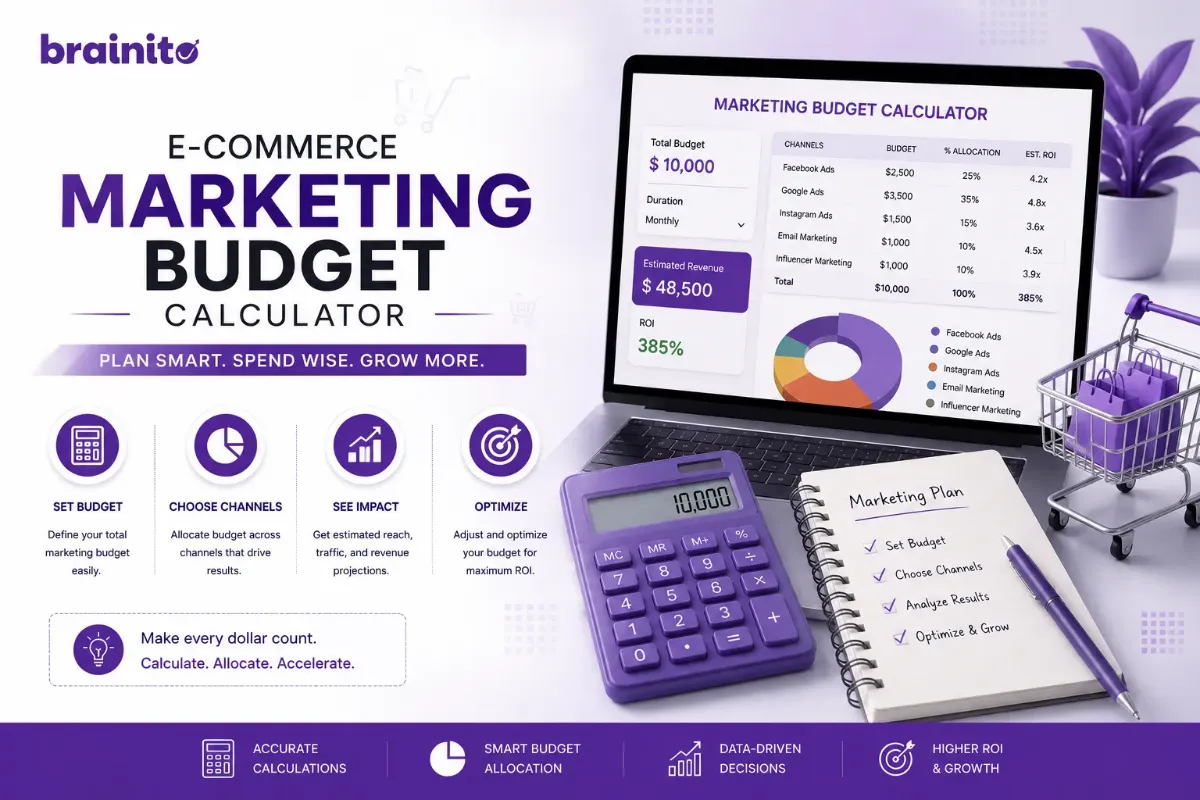
Learn how to size and split your e-commerce marketing budget across SEO, ads, email, and social with a simple 2026 calculator framework and channel benchmarks.
Why E-Commerce Marketing Budgets Are So Hard to Set
Ask ten store owners how much they spend on marketing and you will get ten very different answers. That is because there is no single correct number. The right e-commerce marketing budget depends on your margins, your average order value, how repeat-friendly your products are, and how aggressively you want to grow this year.
The mistake most founders make is picking a number that feels comfortable rather than one the math supports. A budget that is too small starves your best channels before they can compound. A budget set without unit economics in mind quietly bleeds cash on traffic that never converts. The goal of a marketing budget calculator is to replace gut feel with a few honest inputs, then let those inputs tell you what you can actually afford to spend to win a customer.
Before you allocate a single dollar, it helps to know where your current spend is leaking. A free marketing audit scores your store across 77 factors and returns a prioritized action plan, so you start budgeting from facts rather than assumptions.
The Core Numbers Every Calculator Needs
A useful budget calculator is built on a handful of metrics. Get these right and the rest is arithmetic.
Customer Acquisition Cost (CAC)
CAC is the total amount you spend to win one new customer. Divide your marketing spend over a period by the number of new customers it produced. If CAC creeps above what a customer is worth, you are buying growth at a loss.
Lifetime Value (LTV)
LTV estimates the total profit a customer delivers across every order they will ever place. A healthy store aims for an LTV to CAC ratio of roughly 3 to 1. If a customer is worth 150 dollars in margin, spending up to 50 dollars to acquire them is sustainable.
ROAS and Conversion Rate
Return on ad spend (ROAS) tells you how many dollars of revenue each ad dollar generates. Paired with your store conversion rate and average order value, ROAS lets you forecast how much paid traffic you need to hit a revenue target. These four numbers, CAC, LTV, ROAS, and conversion rate, are the engine of any credible budget model.
How Much Should You Spend? Two Sizing Methods
There are two practical ways to set a total marketing budget, and the best plans use both as a sanity check against each other.
The Percentage-of-Revenue Method
Many established e-commerce brands spend between 7 and 12 percent of revenue on marketing, while brands in an aggressive growth phase often push to 15 or 20 percent. If you did 500,000 dollars in sales last year and target steady growth, a 10 percent budget gives you 50,000 dollars to work with. New stores fighting for their first traction usually need to over-index here, because awareness is expensive before word of mouth kicks in.
The Goal-Based Method
Work backwards from a target instead. If you want 1,000 new customers this year and your blended CAC is 30 dollars, you need 30,000 dollars in acquisition spend, plus a buffer for retention and content. When the two methods disagree wildly, that gap is a signal to revisit your pricing, margins, or growth assumptions. Mapping this out in a structured DIY marketing plan keeps the budget tied to outcomes rather than vanity reach.
Allocating Across Channels in 2026
Once you know the total, the harder question is how to split it. Each channel has a different cost profile and payback window, so a balanced portfolio matters more than chasing one shiny tactic.
Search and SEO
Organic search is the highest-leverage line item because it compounds. Spend here goes toward content, technical fixes, and links rather than per-click fees. Plan your topics with a content calendar generator and validate demand using a keyword research tool before you commit writers. Sellers on marketplaces should also lean on an Amazon keyword research tool to capture high-intent shoppers.
Paid Ads
Google and Meta ads buy speed. Reserve 30 to 50 percent of a growth budget here, structure campaigns tightly with a Google ad structure generator, and sharpen creative with a Facebook ad copy generator so you are not burning budget on weak hooks.
Email and Retention
Email remains the cheapest revenue per dollar in e-commerce. A small slice of budget on flows and a sharper subject line, helped by an email subject line generator, often returns more than any paid channel.
Building Your Calculator Step by Step
You can build a working budget model in a spreadsheet in under an hour. Follow this sequence.
Step 1: Enter Your Baseline
List your average order value, gross margin, conversion rate, and current CAC. These are your constraints. If you do not have clean numbers yet, estimate conservatively and refine after your first month of data.
Step 2: Run a Small Pilot
Before committing a full annual budget, test each channel with a modest amount over four to six weeks. Pilots replace guesses with real CAC and ROAS figures per channel, which is the data your calculator actually needs.
Step 3: Allocate, Then Review Monthly
Pour budget into the channels that hit your target ratios and trim the ones that do not. Treat the budget as a living document, not a fixed annual contract. If building and maintaining this in-house feels heavy, you can hire a marketer to own the model, or compare done-for-you options on the pricing page.
Common Budgeting Mistakes to Avoid
Even a well-built calculator fails if the inputs or habits around it are wrong. Watch for these traps.
Ignoring retention. Pouring everything into acquisition while neglecting email and loyalty inflates your CAC and shortens LTV. A retained customer is far cheaper than a new one.
Setting and forgetting. Costs per click, seasonality, and competition shift constantly. A budget reviewed once a year is a budget that is wrong eleven months out of twelve.
Spreading too thin. Funding six channels at starvation levels usually beats none of them. Concentrate budget where your pilots showed traction, then expand. For more frameworks and worked examples, the Brainito blog covers channel-by-channel tactics in depth, and a fresh free marketing audit will flag exactly which areas deserve more of your spend next quarter.
Frequently Asked Questions
What percentage of revenue should an e-commerce business spend on marketing?
Most established stores spend between 7 and 12 percent of revenue, while brands in a fast growth phase often invest 15 to 20 percent. Newer stores usually need to spend a higher share early because building awareness costs more before repeat customers and word of mouth take over.
How do I split my budget across channels?
Start with your unit economics, then run short pilots so you have real CAC and ROAS per channel. A common starting split is a steady investment in SEO and email for compounding returns, with 30 to 50 percent going to paid ads for speed, adjusted monthly based on which channels actually hit your target ratios.
How often should I update my marketing budget?
Review it monthly. Click costs, seasonality, and competition change throughout the year, so treat the budget as a living model. Running a periodic free marketing audit helps you spot shifts early and reallocate before performance slips.