Build an app launch marketing plan that actually drives installs in 2026. Pre-launch buzz, ASO, paid acquisition, PR, content, and retention covered.
Why Most App Launches Stall (And How a Plan Fixes It)
Shipping a great app is only half the job. The harder half is getting people to find it, download it, and keep opening it. With millions of apps competing for attention across the stores, a polished product with no audience simply disappears. An app launch marketing plan is the difference between a quiet release and a measurable surge of installs that compounds over time.
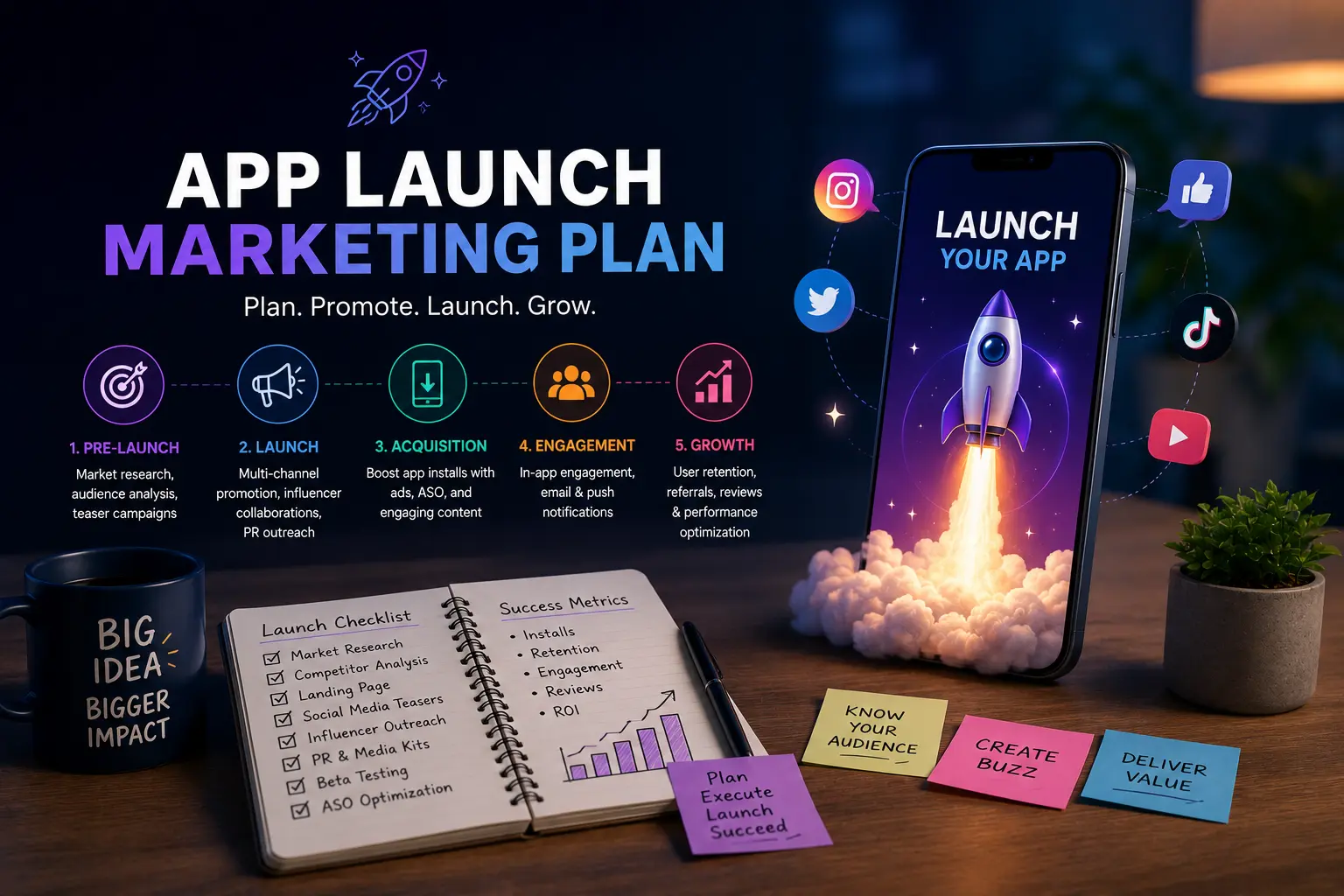
The mistake teams repeat is treating launch as a single event. They flip the switch on launch day, watch a small spike, then wonder why downloads flatten a week later. A real plan treats marketing as a continuous engine that runs before, during, and long after release. This guide walks through every stage: pre-launch, App Store Optimization, paid acquisition, PR, content, and retention.
If you want a quick read on where your wider marketing stands before you invest in a launch, run a free marketing audit. It scores your web presence across 77 factors and hands back a prioritized action plan, so you launch from a position of strength rather than guesswork.
Pre-Launch: Build the Audience Before You Ship
The most successful launches start weeks or months before the app is live. Your goal in this phase is to assemble an audience that is ready to download on day one, because the stores reward early velocity with better ranking.
Validate with real users first
Run a closed beta with a small group that matches your target customer. Watch where they get stuck, what confuses them, and which moments make them smile. Fixing friction now protects your reviews later. Early one-star ratings are very hard to outrun.
Create a waitlist and a landing page
Stand up a simple landing page that explains the core benefit and captures emails. Tease the launch on social channels, share behind-the-scenes progress, and give early subscribers a reason to stay engaged, such as a founding-member badge or a head start on premium features.
Prepare your creative assets
Have your launch banners, demo video, screenshots, and store copy ready before launch day, not scrambled together at the last minute. A short, sharp demo video that shows the app solving one clear problem is worth more than a long feature tour. If you need a structured starting point for the whole effort, a DIY marketing plan template helps you map channels and timelines.
App Store Optimization: Win Visibility in the Stores
App Store Optimization (ASO) is the organic backbone of any launch. Most app discovery still happens through store search, so ranking for the right terms quietly drives installs every single day at no media cost.
Keyword research drives everything
Start by identifying the words real people type when they look for an app like yours. Map high-intent terms to your title, subtitle, and keyword field. The same discipline you would use for product listings applies here. Our Amazon keyword research tool is handy for surfacing the kind of buyer-intent phrases that translate well to app store search, and the Google keyword research tool helps you gauge demand and seasonality.
Optimize the listing for conversion
Visibility means nothing if the listing does not convert. Lead with a benefit-driven title, use your first two screenshots to show the core value instantly, and surface social proof through ratings and short testimonials. Localize your listing for the markets you care about, since translated store pages often lift conversion noticeably.
Treat ASO as ongoing work
Rankings shift as competitors update and search behavior changes. Revisit your keywords and creative every few weeks, test new screenshots, and watch which terms actually deliver installs. ASO is a habit, not a one-time setup.
Paid Acquisition: Buy Installs That Pay Back
Once organic foundations are in place, paid acquisition lets you scale on demand. The key is to buy installs that turn into retained, paying users rather than vanity download counts.
Pick channels that match intent
App campaigns across Google and Apple Search Ads capture people already searching, which tends to produce higher-intent installs. Paid social on Facebook, Instagram, and TikTok is better for sparking demand and reaching lookalike audiences who have never heard of you.
Lead with creative, then optimize cost
On mobile, creative is the biggest lever. Test multiple hooks, video lengths, and value propositions, and let the winners scale. If you run paid social, our Facebook ad copy generator speeds up the testing cycle, and for search-style campaigns the Google ad structure generator keeps your account organized around clear themes.
Measure cost per retained user
Cost per install is a starting metric, not the finish line. Track cost per retained user and cost per paying user, then move budget toward the channels and creatives that deliver real value. Set up retargeting for people who installed but never activated, nudging them back with a clear next step.
PR, Influencers, and Content: Build Trust at Scale
Paid channels buy reach, but earned attention builds credibility. A coordinated PR, influencer, and content push gives your launch the social proof that pure advertising cannot.
Run a focused PR push
Pitch journalists and niche newsletters that genuinely cover your category. A tight story angle, a clear founder narrative, and an embargoed launch date give writers a reason to publish on your timeline. Even a handful of well-placed mentions create backlinks and trust signals that compound over time.
Partner with creators who share your audience
Influencers and bloggers whose followers overlap with your ideal user can drive sustained installs through honest recommendations. Prioritize relevance and engagement over raw follower counts. A creator with 20,000 deeply engaged followers often outperforms a celebrity with millions of passive ones.
Publish content that compounds
Content marketing keeps working long after launch day. Blog posts, comparison guides, and how-to articles capture search traffic and warm up future users. Plan it deliberately with a content calendar generator so your publishing stays consistent across the launch window and beyond.
Retention: Where the Real Growth Happens
Acquisition gets the headlines, but retention pays the bills. An app that loses most users in the first week needs a constantly refilling top of funnel just to stay flat. Keeping users is cheaper and more durable than chasing new ones.
Nail the first session
Your onboarding should get a new user to their first meaningful win as fast as possible. Strip away friction, explain only what is essential, and celebrate the moment value clicks. The faster someone experiences the core benefit, the more likely they are to return.
Re-engage with purpose
Use push notifications, email, and in-app messages thoughtfully. Personalize based on behavior, reward returning users with relevant incentives, and avoid the spammy blasts that drive uninstalls. Promotions and milestone rewards work best when they feel earned rather than desperate.
Improve continuously and listen
Ship regular updates, fix bugs quickly, and respond to reviews. Users notice when a team is actively improving the product, and that responsiveness shows up in ratings and word of mouth. To keep your wider strategy sharp as you scale, revisit your free marketing audit periodically, and if your team needs more firepower you can always hire a marketer to run the engine for you.
Frequently Asked Questions
How far in advance should I start marketing my app launch?
Start at least six to eight weeks before launch, and earlier for complex products. That window lets you build a waitlist, run a beta, refine your ASO, and warm up press and creators so you arrive on launch day with momentum instead of starting from zero. A structured DIY marketing plan helps you sequence these tasks.
Should I prioritize ASO or paid ads first?
Get your ASO foundations right before pouring money into paid. Strong store keywords, screenshots, and reviews improve conversion for every visitor, including the paid ones, so paid traffic performs better and costs less when your listing is already optimized.
What single metric matters most after launch?
Retention, usually measured by how many users return on day seven and day thirty. High retention signals real product value, lowers your effective acquisition cost, and tells you the app is ready to scale. If retention is weak, fix the product experience before spending more on installs, and run a free marketing audit to spot gaps across your funnel.