Proven marketing strategies for web development companies in 2026: niche positioning, portfolio SEO, paid ads, and client retention that fill your pipeline.
Why Web Development Companies Struggle to Market Themselves
Here is the irony most agency owners eventually notice. You can build a flawless website for a client, ship it on time, and watch their traffic climb. Yet your own pipeline runs dry the moment your last referral fades. Technical skill and marketing skill are different muscles, and the businesses that grow are the ones that treat their own demand generation as seriously as a paying engagement.
The web development market in 2026 is crowded. Low-cost offshore shops, no-code builders, and AI site generators have all pushed buyers to expect more for less. To win, you cannot compete on price. You have to compete on positioning, proof, and a steady marketing system that brings the right clients to your door before they ever talk to a competitor.
This guide walks through the strategies that actually move the needle for development firms, from sharpening your niche to keeping clients long after launch. If you would rather see exactly where your own marketing stands first, our free marketing audit scores your site across 77 factors and hands you a prioritized action plan.
Pick a Niche and Position Around It
The fastest way to stop competing on price is to stop being a generalist. A firm that says "we build websites" sounds like ten thousand others. A firm that says "we build conversion-focused Shopify stores for skincare brands" sounds like the obvious choice for exactly that buyer. Specialization lets you charge more, sell faster, and produce sharper case studies because every project reinforces the same expertise.
How to Choose a Niche That Pays
Look at your past work and ask three questions. Which projects were most profitable? Which clients were easiest to work with? Which industries do you genuinely understand? The overlap is your niche. You do not have to abandon other work overnight, but your marketing message, your portfolio, and your outreach should all point in one direction.
Once you have a niche, build the messaging to match. A focused marketing plan keeps your homepage, ads, and content all speaking to the same buyer instead of diluting your pitch across five audiences at once.
Turn Your Portfolio and Website Into Lead Engines
For a development company, your website is the product demo. If your own site is slow, dated, or hard to navigate, no portfolio piece will undo that first impression. Prospects assume your work will look like your storefront, so the storefront has to be your best argument.
Build Case Studies, Not Just Screenshots
A gallery of pretty thumbnails proves you can design. Case studies prove you can deliver results. For each flagship project, write up the client's problem, what you built, and the measurable outcome: load time cut in half, conversions up 40 percent, checkout abandonment down. Numbers turn a portfolio from decoration into a sales asset.
Optimize the Site for Search
Your portfolio pages are also SEO real estate. Target phrases like "ecommerce website developer for [industry]" and let each case study rank for the work you want more of. If you are not sure which terms to chase, our keyword research tool surfaces the searches your future clients actually type. To pressure-test your overall site health and find the technical issues dragging your rankings, run the free marketing audit.
Get Found: SEO, Directories, and Q&A Communities
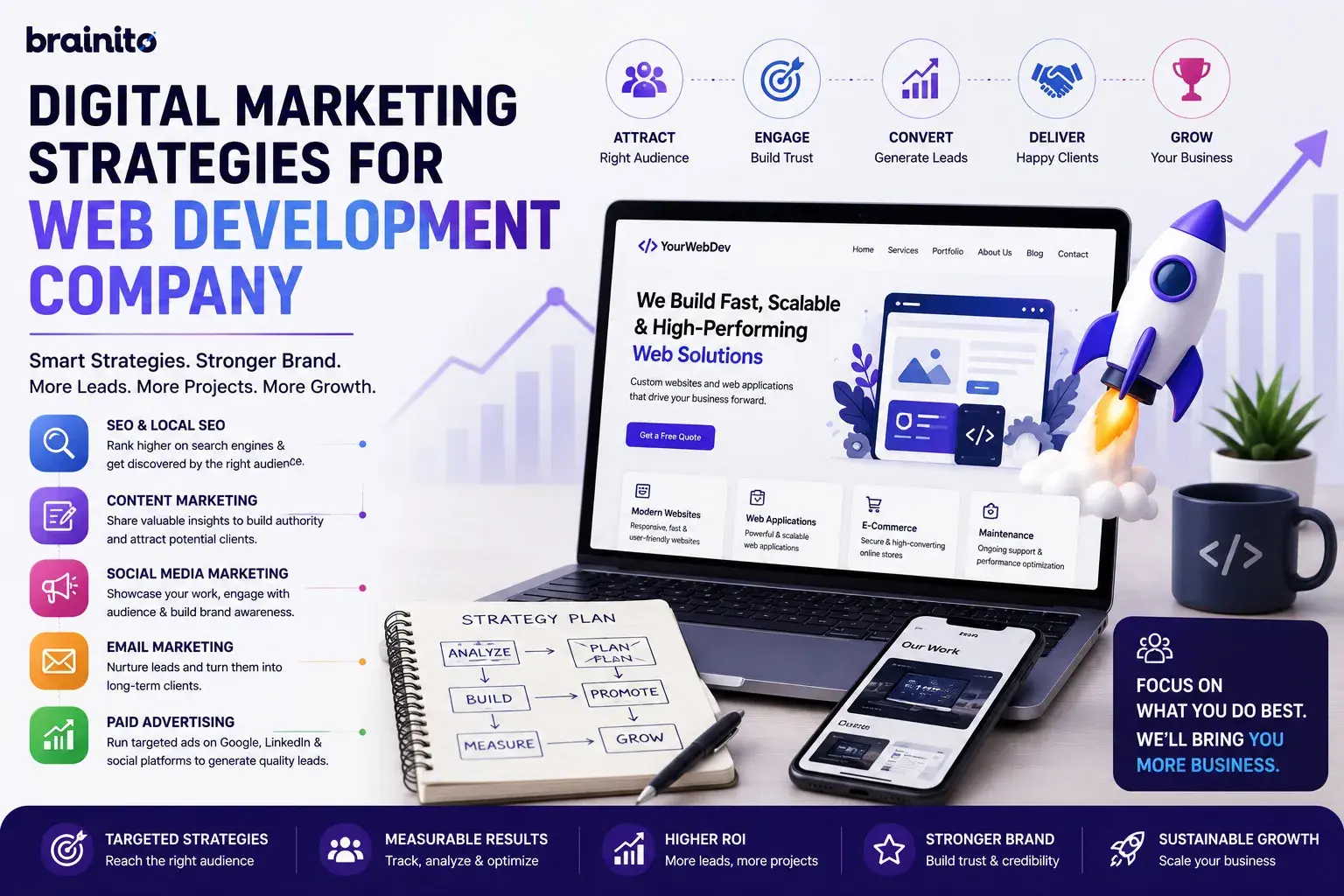
Organic visibility is the compounding asset of agency marketing. It is slower than ads, but once you rank, qualified leads arrive without paying per click. Three channels work especially well for development firms.
SEO and Content
Publish content that answers the questions buyers ask before hiring: how to choose a developer, what a build should cost, how long a project takes. Educational content earns trust and links. A simple content calendar keeps you publishing consistently instead of in unpredictable bursts, and our blog content generator helps you draft those posts faster.
Directories and Review Platforms
List your firm on Clutch, DesignRush, and similar B2B directories. Buyers comparing agencies start there, and verified reviews carry real weight. A handful of detailed client reviews can outperform months of cold outreach.
Developer Communities
Answering questions on Stack Overflow, GitHub discussions, and niche forums quietly builds authority. You are not selling, you are demonstrating competence in front of the exact people who refer or hire developers. Over time those contributions surface your name when someone needs a build.
Paid Ads and Social Media for Faster Demand
SEO builds slowly, so pair it with channels that produce leads now. Paid search and a focused social presence fill the gap while your organic footprint grows.
Run Tight Google Ads Campaigns
Google Ads put you in front of buyers with active intent: people searching "hire web developer" or "custom Shopify build" today. The trick is structure. Tight ad groups and specific landing pages beat broad campaigns every time. Our Google ad structure generator helps you organize campaigns so you stop wasting budget on irrelevant clicks.
Use Social to Show Process, Not Just Results
On LinkedIn and other platforms, the agencies that win attention show the work behind the work: a refactor that fixed a slow page, a before-and-after of a redesign, a short breakdown of a tricky build. This positions you as a practitioner, not a vendor. When you do run social ads, sharpen the messaging with a Facebook ad copy generator so each post earns its spend.
Keep Clients and Turn Them Into Referrals
The cheapest lead is the client you already have. Development work has natural recurring needs: maintenance, new features, performance tuning, redesigns. A client who trusts you will keep coming back and will send others your way, but only if you stay top of mind after launch.
Build a Retention System
Set up a simple post-project rhythm: a quarterly check-in, a short newsletter with tips relevant to their stack, and a clear referral offer. A well-written email keeps you present without being pushy, and an email subject line generator helps those messages actually get opened.
If you want a partner to build and run this whole engine rather than assembling it piece by piece, you can hire a marketer to own your demand generation while you focus on shipping great work. Either way, start by knowing where you stand. The free marketing audit shows exactly which gaps to close first.
Frequently Asked Questions
How long does it take for marketing to bring web development clients?
Paid channels like Google Ads can produce qualified leads within days, while SEO and content typically take three to six months to gain real traction. The strongest approach runs both at once: ads fill the pipeline now while organic visibility compounds for the long term. Retention and referrals then lower your cost per client over time.
What is the single most important marketing asset for a web development company?
Your own website and portfolio. Because you sell websites, your site is living proof of your ability. A fast, polished site with results-driven case studies will outperform almost any ad campaign, since buyers judge your skill by what you built for yourself before they ever read a pitch.
How do I know which marketing strategy to start with?
Start by diagnosing where you are weakest. Run the free marketing audit to score your site across 77 factors and get a prioritized action plan, then tackle the highest-impact fixes first instead of spreading effort thin across every channel at once.