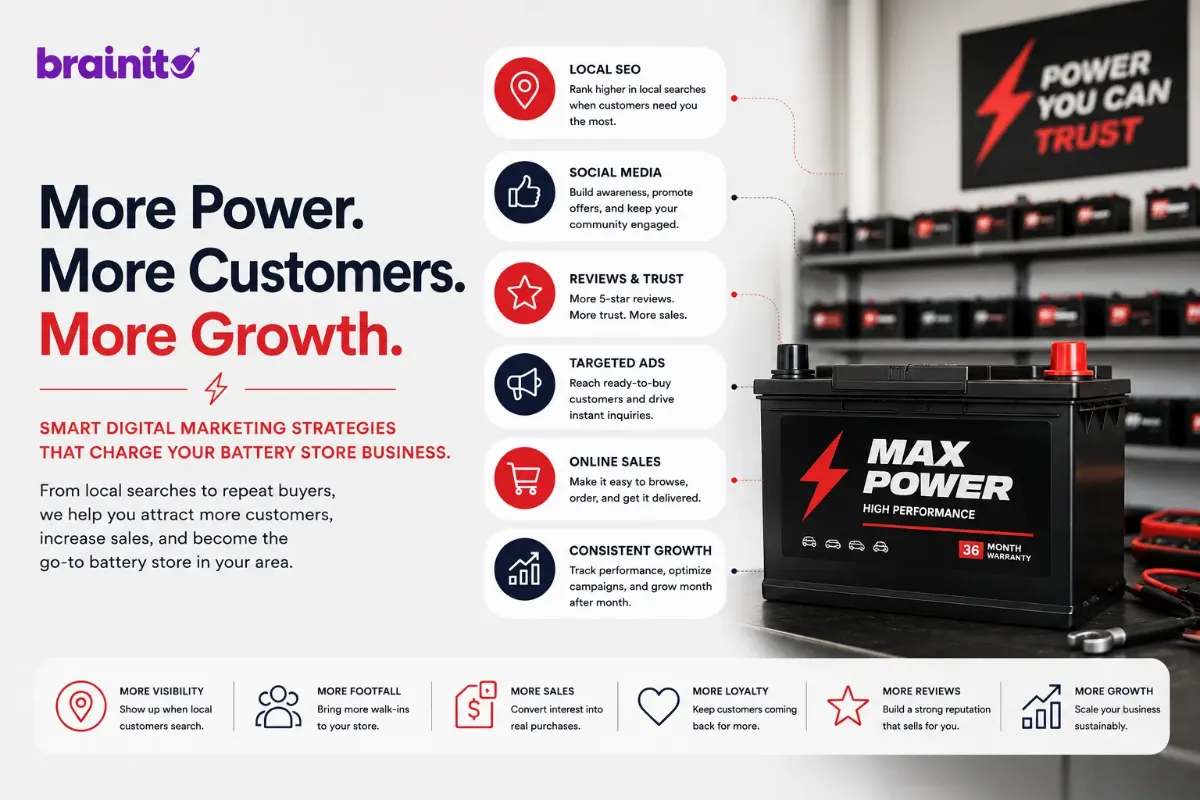
Practical marketing strategies for battery stores in 2026: local SEO, paid ads, e-commerce, and retention tactics to win more customers and repeat sales.
Why Battery Stores Need a Sharper Marketing Plan
Batteries are a low-interest, high-need purchase. People rarely shop for them until something dies: a car, a smoke detector, a power tool, or a backup system during an outage. That buying behavior makes a battery store both easy and hard to market. Easy, because demand is constant. Hard, because customers default to whoever is closest, cheapest, or first in the search results.
The stores that win in 2026 are the ones that show up at the exact moment of need and stay memorable enough to earn the next purchase. That takes a deliberate plan across local visibility, digital advertising, e-commerce, and retention. If you want a fast read on where your current marketing stands, start with a free marketing audit that scores your website across 77 ranking and conversion factors and returns a prioritized action plan.
Build a Brand Customers Remember
Most battery retailers look interchangeable. Same shelves, same brands, same pricing. A distinct identity is your cheapest competitive advantage because it costs nothing to repeat and everything to ignore.
Define a clear positioning
Decide what you stand for. Maybe it is the widest selection of hard-to-find batteries, the fastest car battery replacement in town, or the only store that recycles old cells for free. Pick one promise and put it on your signage, your receipts, and your homepage.
Make packaging and presentation work for you
If you sell private-label or bundled products, clean packaging signals quality and justifies a higher price. In-store, group products by use case (automotive, home, electronics, industrial) so customers find what they need without asking. A consistent look across your store, vehicle wraps, and online listings builds recognition over time.
Win Local Search and Foot Traffic
For a physical battery store, local search is the single highest-return channel. When someone types "car battery near me" or "where to buy AA batteries," you want to be in the map pack.
Optimize your Google Business Profile
Claim and fully complete your profile: accurate hours, categories, photos of the storefront and product range, and a steady flow of reviews. Respond to every review, positive or negative. Run a quick GMB audit to spot gaps that are costing you map placement.
Target the keywords people actually use
Build pages around real search terms like "marine battery replacement" or "watch battery service." Use a keyword research tool to find the phrases with local demand, then create content that answers those queries. Pair this with classic local SEO content on your blog to capture long-tail searches your competitors ignore.
Traditional outdoor marketing still helps here. Clear signage and a well-placed billboard near high-traffic roads reinforce the digital impressions and pull in drivers who suddenly need a battery.
Use Paid Ads to Capture Demand at the Right Moment
Paid advertising lets you reach buyers the instant they search or scroll. The trick is matching the ad to intent.
Search ads for high-intent buyers
Google search ads work best for urgent, transactional queries. Someone searching "12V car battery price" is ready to buy. Structure tightly themed ad groups so each keyword maps to a relevant landing page. A Google ad structure generator can help you organize campaigns that do not waste budget on broad, irrelevant clicks.
Social ads for awareness and retargeting
Facebook and Instagram ads are strong for building local awareness and retargeting people who visited your site but did not buy. Use a Facebook ad copy generator to test angles quickly: seasonal reminders before winter, power-outage preparedness, or a contest entry. Keep creative simple and lead with the benefit, not the spec sheet.
Expand Online and Keep Customers Coming Back
A battery store no longer has to rely on walk-ins. E-commerce and marketplaces extend your reach far beyond your zip code.
Sell on your site and on Amazon
List your products on your own website for margin and on Amazon for volume. Optimize Amazon listings with the terms shoppers actually type using an Amazon keyword research tool, so your products surface above generic competitors. Bundles and subscription options for high-turnover items like AAs or hearing-aid batteries lift average order value.
Drive repeat purchases with email and retargeting
Batteries are inherently a repeat purchase, which makes retention marketing unusually profitable. Collect emails at checkout and send timely reminders: replacement cycles, seasonal prompts, and restock offers. Strong subject lines decide whether those emails get opened, so test variations with an email subject line generator. Pair email with retargeting ads to re-engage past visitors at a low cost per sale.
If planning all of this feels like a lot, a structured DIY marketing plan gives you a step-by-step framework to execute without guessing.
Turn Strategy Into an Execution Plan
Strategy only matters if it ships. The most common failure point for battery stores is not a lack of ideas, it is a lack of sequencing and follow-through.
Prioritize by effort and return
Start with the highest-leverage moves: a fully optimized Google Business Profile, a handful of local landing pages, and one paid channel you can measure. Add e-commerce and retention layers once the basics are producing leads.
Get help when you need it
If your team is stretched, you do not have to do everything in-house. You can hire a marketer to run campaigns, or compare options on the pricing page. Before committing budget, run a free marketing audit so every dollar goes toward the fixes that move the needle first.
Frequently Asked Questions
What is the most cost-effective marketing channel for a battery store?
For a physical store, local search is usually the best return. An optimized Google Business Profile and local SEO pages put you in front of high-intent buyers searching "battery near me" at almost no media cost. Layer in retargeting and email once that foundation is in place, since those re-engage existing visitors cheaply.
How do I get repeat customers when batteries last a long time?
Capture emails at checkout and send replacement-cycle reminders, seasonal prompts, and restock offers. Subscriptions for fast-moving items like AA or hearing-aid batteries also lock in recurring revenue. Pair this with retargeting ads so past buyers see you again at the moment they need a replacement.
Should a small battery store invest in paid ads or focus on SEO first?
Do both, but sequence them. SEO and a strong Google Business Profile build durable, free visibility over time. Paid search captures urgent buyers immediately while your organic presence grows. Start with one measurable paid channel, and let a free marketing audit tell you where your budget will produce the fastest wins.