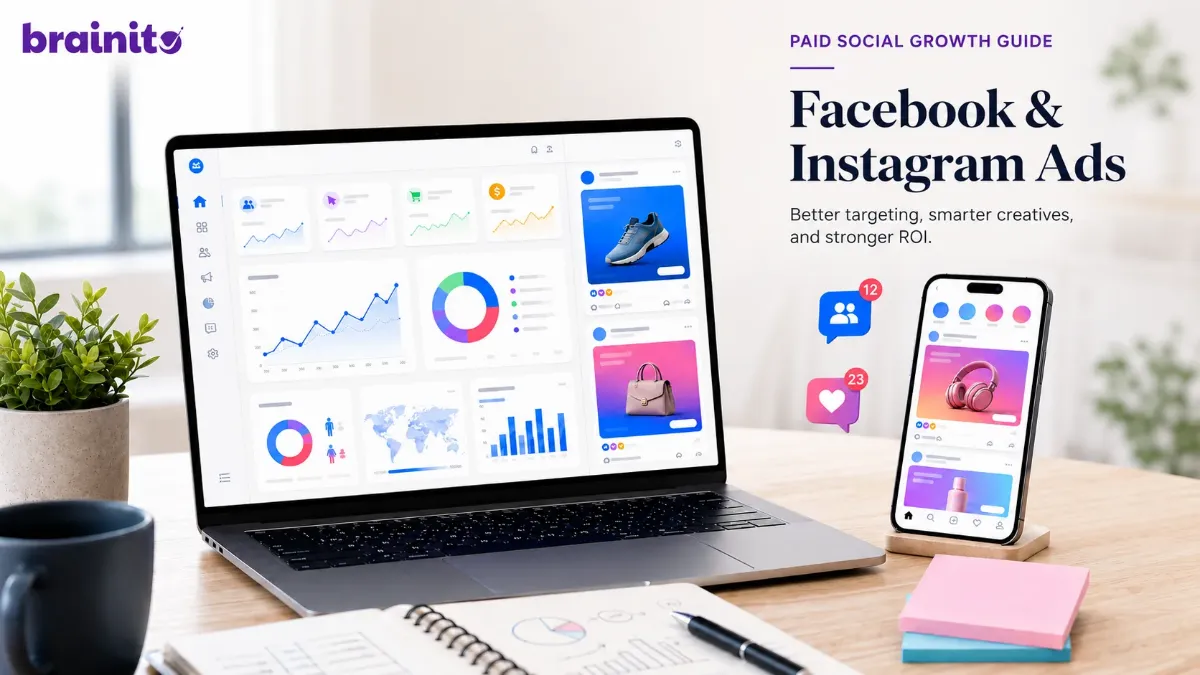
Learn how to plan, target, and optimize Facebook and Instagram ads in 2026. A practical playbook for higher ROAS, better creative, and smarter targeting.
Why Facebook and Instagram Ads Still Win in 2026
Meta's ad ecosystem remains the most powerful paid channel for small and mid-sized businesses. Together, Facebook and Instagram reach billions of active users every day, and the platform's machine learning has only gotten sharper at matching your offer to the people most likely to buy. For most brands, this is where paid social delivers the clearest, most measurable return.
The reason is simple: intent plus data. Google captures people who are already searching. Meta captures people before they search, using behavioral signals, interests, and lookalike modeling to put your product in front of a warm audience. When your creative and targeting align, you can generate demand rather than just harvest it.
The Three Pillars of a Profitable Campaign
Every high-performing Meta campaign rests on three pillars: a clear objective, a sharp audience, and creative that stops the scroll. Weakness in any one of them drags down the entire account. Before you spend a dollar, make sure you can name your objective, describe your ideal customer in one sentence, and point to the specific ad that will earn their attention. If you are unsure where your fundamentals stand, a free marketing audit scores your site and funnel across 77 factors and hands back a prioritized action plan.
Setting the Right Campaign Objective
Meta's Ads Manager asks you to pick an objective before anything else, and this choice tells the algorithm what to optimize for. Choosing the wrong one is the single most common way to waste budget. A "reach" campaign will happily show your ad to a million people who never convert, while a "conversions" campaign hunts for buyers.
Match Objective to Funnel Stage
Think in terms of the funnel. Use awareness and reach objectives for top-of-funnel brand building. Use traffic and engagement for the middle, warming up people who are curious but not ready. Reserve conversions, leads, and sales objectives for the bottom, where you ask for the purchase or the signup.
A frequent mistake is jumping straight to conversions with a brand-new pixel and no audience data. The algorithm needs conversion events to learn. If you are just starting, run traffic or engagement first to build a pool of warm users, then retarget them with a conversion campaign. Mapping this sequence is far easier when you have a written plan. Our DIY marketing plan walks you through building that funnel step by step.
Targeting: Reaching the Right Audience
Targeting is where Meta earns its reputation. You have three broad audience types to work with, and the best accounts layer all three across the funnel.
Custom, Lookalike, and Interest Audiences
Custom audiences are your warmest prospects: past website visitors, email subscribers, and people who engaged with your posts. These convert at the highest rates because they already know you. Upload your customer list or install the Meta pixel to build them.
Lookalike audiences take a source audience (your buyers, for example) and ask Meta to find millions of similar people. A 1% lookalike is tight and high-quality; a 5% or 10% lookalike is broader and cheaper. Start narrow and expand as you gather data.
Interest and behavior audiences let you target by hobbies, job titles, life events, and purchase behavior. In 2026, broad targeting paired with strong creative often outperforms hyper-granular stacking, because Meta's algorithm finds the buyers for you when you give it room to learn.
Before you build audiences, get clear on the keywords and themes your customers actually care about. Our keyword research tool surfaces the language your audience uses, which sharpens both your targeting and your ad copy.
Choosing Ad Formats That Convert
Meta offers a rich menu of ad formats, and the right one depends on your goal and your creative assets. Using the wrong format for the message is like showing a billboard where a demo video belongs.
The Formats Worth Mastering
Image ads are the fastest to produce and still convert well for clear, single-product offers. Video ads dominate feeds and Reels, giving you room to demonstrate value and build emotion. Carousel ads let you showcase multiple products or tell a step-by-step story in one unit, which is ideal for ecommerce.
Collection and instant experience ads create a full-screen mobile shopping moment, perfect for catalogs. Stories and Reels ads tap into the vertical, immersive placements where attention now lives, especially with younger audiences.
Whatever format you choose, the hook in the first three seconds and the first line of copy decide everything. If writing scroll-stopping copy is your bottleneck, the Facebook ad copy generator gives you a fast head start on headlines and primary text you can then refine.
Creative and Copy: The Real Performance Lever
In 2026, targeting is increasingly automated, which means creative is the biggest variable you actually control. Two accounts with identical audiences and budgets can see wildly different returns based on creative quality alone. Treat creative as your primary optimization lever, not an afterthought.
What Strong Creative Looks Like
Great Meta creative is native to the platform. It feels like content, not an interruption. Lead with a hook that names a problem or a bold benefit. Show the product in use. Use captions, because most people watch with sound off. Keep the offer and call to action unmistakable.
Volume matters too. The best advertisers ship many creative variations and let performance decide the winners, rather than betting everything on one polished asset. Build a repeatable creative pipeline so you always have fresh angles to test. A content calendar generator helps you plan that steady stream of assets so your ad account never goes stale.
Testing, Measuring, and Scaling
No campaign launches perfect. The advertisers who win are the ones who test relentlessly and read the data honestly. Set up structured A/B tests that change one variable at a time: audience, creative, headline, or placement. Testing everything at once tells you nothing about what actually moved the needle.
The Metrics That Matter
Watch return on ad spend (ROAS) and cost per acquisition (CPA) as your north-star numbers, but diagnose problems with upstream metrics. A low click-through rate points to weak creative. A high CTR with poor conversions points to a landing page or offer problem. Fixing the right layer saves money.
Once a campaign is profitable, scale carefully. Raise budgets gradually (roughly 20 to 30 percent every few days) so you do not reset the learning phase, and duplicate winners into new audiences rather than overloading a single ad set. If your landing pages are leaking conversions, a free marketing audit pinpoints exactly where visitors drop off before they buy. And if managing all of this in-house is stretching your team thin, you can always hire a marketer to run and optimize the account for you.
Frequently Asked Questions
How much should I budget for Facebook and Instagram ads?
Start with a budget that lets you gather meaningful data, often a few hundred dollars per month at minimum, so the algorithm can exit the learning phase. What matters more than the absolute number is your return on ad spend. Begin small, prove the funnel converts, then scale spend on the campaigns that are profitable. Use the numbers from a free marketing audit to decide where your first dollars will work hardest.
Should I run ads on Facebook, Instagram, or both?
In most cases, both. Meta's Advantage+ placements automatically distribute your ads across Facebook feeds, Instagram, Stories, and Reels, then optimize toward the placements that perform. Let the algorithm test across surfaces first, then narrow to the winners once you have data. Different audiences and formats simply live in different places.
How long until I see results?
Expect a learning phase of roughly one to two weeks while Meta gathers conversion data. Early numbers will be noisy, so resist the urge to make big changes daily. Give each test enough spend and time to reach statistical significance. For a structured launch and testing roadmap, our DIY marketing plan lays out a realistic timeline.