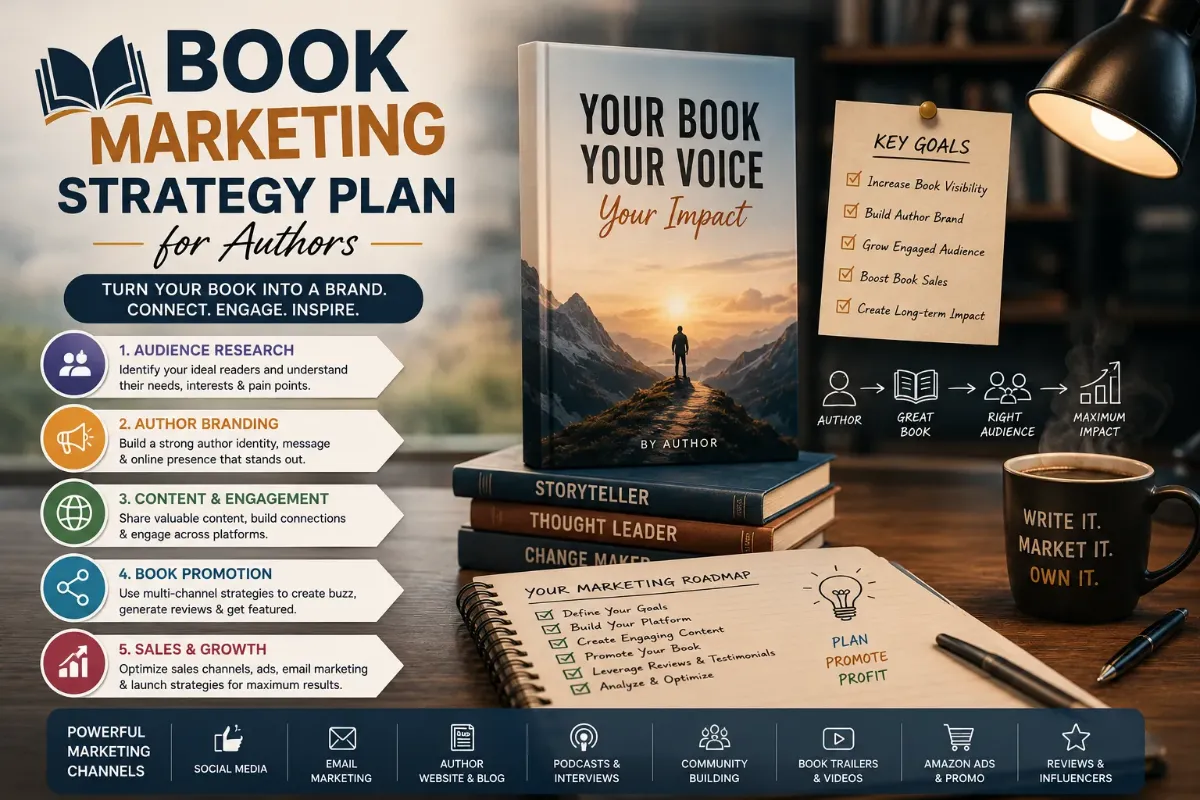
Build a book marketing strategy plan that sells. A 2026 author playbook covering pre-launch, email, SEO, social, paid ads, and launch-week tactics.
Why Every Author Needs a Marketing Plan, Not Just a Manuscript
Writing the book is the hard part, but it is only half the job. A great manuscript with no marketing plan tends to sit quietly in the long tail of a retailer catalog, invisible to the readers who would love it. A book marketing strategy plan is simply the bridge between your finished words and the people who will pay for them.
The good news for authors in 2026 is that the tools to reach readers have never been more accessible. The challenge is that everyone has those same tools, so a clear, sequenced plan beats scattered effort every time. Think of marketing as a campaign that starts months before launch and continues long after, not a single burst of activity on release day.
What a Real Plan Looks Like
A workable plan answers four questions: who is your reader, where do they already spend attention, what message moves them, and how will you measure progress. If you can answer those, you have the skeleton of a strategy. If you cannot, that is your first task. Before you spend a dollar on ads or design, it helps to benchmark where you stand today with a free marketing audit so you know which channels deserve your limited time.
Nail Your Positioning: Title, Cover, and Description
Most buying decisions happen in seconds, and three assets carry that weight: your title, your cover, and your description. Together they are your storefront. Get them right and discovery does some of your selling for you.
A Title That Is Searchable and Memorable
Your title should be evocative, but the subtitle is where strategy lives. A clear subtitle with the language your readers actually search for helps your book surface in retailer results and search engines alike. Use a keyword research tool to see how people phrase the problem your book solves, then echo that language naturally.
A Cover That Signals Genre Instantly
Readers judge covers, and they should. A strong cover communicates genre and quality in a glance. Invest in professional design rather than improvising, because an amateur cover quietly caps your sales no matter how good the writing is.
A Description That Sells the Transformation
Your description, up to roughly 200 words, should lead with the reader benefit or emotional hook, not a plot recap. Open with a line that creates tension or curiosity, then deliver proof and a reason to buy now. Treat it like ad copy, because that is exactly what it is.
Build Your Author Platform Before Launch
The single biggest predictor of a strong launch is an audience that already trusts you. You cannot build that overnight, which is why platform work should begin months ahead. The two pillars are an email list and a content presence.
Start an Email List Early
Email is the only channel you fully own. Algorithms change and platforms rise and fall, but a subscriber list travels with you across every book you ever publish. Offer a meaningful lead magnet, a sample chapter, a companion checklist, or a short guide, and invite readers to join. Then nurture that list with genuine value so that when launch day arrives, you are emailing fans, not strangers. When you send those announcements, an email subject line generator can lift your open rates noticeably.
Publish Content That Compounds
Blogging early gives search engines time to index and rank your work, so traffic builds before you need it. Write about the themes of your book, your research, and your writing journey. A content calendar keeps you consistent, and a blog content generator helps you draft faster without losing your voice. Consistency over months matters far more than any single viral post.
Use SEO and Social Media to Get Discovered
Discovery in 2026 happens across search and social in equal measure. Your goal is to be present where readers already are, with content that earns attention rather than demanding it.
Search Visibility for Authors
Optimize your author website and blog so that the people searching for your topic, your genre, or even similar authors can find you. Internal links, clear headings, and pages built around real reader questions all help. If you want a structured starting point, a DIY marketing plan walks you through the steps without the agency price tag.
Choose Platforms Deliberately
You do not need to be everywhere. Pick one or two platforms where your readers actually gather and go deep. A nonfiction business author may thrive on LinkedIn and a newsletter, while a fantasy novelist might find their people on visual and short-video platforms. Repurpose one idea into several formats so a single piece of thinking fuels a week of posts. The aim is conversation and community, not a megaphone.
Plan the Launch: Reviews, Press, and Paid Ads
Launch week is where preparation pays off. The momentum you create in the first days shapes how retailer algorithms treat your book for months, so concentrate your energy here.
Line Up Reviews in Advance
Social proof sells. Secure advance readers, beta reviewers, and editorial reviews well before release so your page is not empty on day one. Send advance copies to engaged readers, relevant reviewers, and anyone with a genuine connection to your topic, and make leaving a review effortless.
Earn Press and Speaking Opportunities
Start local and build outward. A thoughtful pitch to a community outlet, a podcast in your niche, or a panel at a relevant event can introduce you to ready audiences. Tailor each pitch to that outlet's audience rather than blasting a generic press release.
Amplify With Targeted Ads
Once your storefront and reviews are solid, paid ads pour fuel on a fire that is already lit. Test small, measure honestly, and scale only what converts. A clean Google ad structure and sharp Facebook ad copy keep your spend efficient. Never advertise a page that is not ready to convert, because traffic to a weak listing just wastes budget.
Turn Your Plan Into Action
A strategy only matters if you execute it consistently. The most common author mistake is treating marketing as a launch-week sprint instead of an ongoing practice. Books build audiences over years, and so does your platform.
Map your activities to a simple calendar: platform building in the months before launch, intensity during launch week, and steady visibility work afterward. Review your numbers monthly and double down on what works. If managing all of this alongside your writing feels like too much, you can hire a marketer to run the campaign while you focus on the next book, or compare options on the pricing page.
Not sure where to begin? Run a free marketing audit on your author website. It scores your site across 77 factors and hands back a prioritized action plan, so you spend your effort on the moves that will actually sell books. For more author-focused tactics, browse the blog.
Frequently Asked Questions
When should I start marketing my book?
Start at least three to six months before launch. Early marketing gives your email list, blog content, and social presence time to grow so you launch to a warm audience instead of starting from zero. The writing and the marketing should overlap, not happen in sequence.
Do I need a budget to market my book effectively?
No. Many of the highest-impact tactics, building an email list, publishing SEO-friendly content, earning reviews, and pitching podcasts, cost time rather than money. Paid ads can accelerate results once your listing converts, but they are an amplifier, not a requirement. Start with a free marketing audit to find your highest-leverage free moves first.
How do I market a book with no existing audience?
Begin by going where your ideal readers already gather and contributing value before you ask for anything. Pick one platform, publish consistently, and offer a lead magnet to start an email list. A structured DIY marketing plan gives you a step-by-step path from zero to a real reader base.