Build a Black Friday campaign that converts in 2026. Plan offers, build your email and ad funnel, and capture demand with this step-by-step guide.
Why Black Friday Campaigns Win or Lose Before November
The brands that crush Black Friday in 2026 are not the ones with the loudest discount. They are the ones that started building demand months earlier and showed up with a clear, well-timed offer to an audience that already trusts them. Black Friday is no longer a single day. It is a multi-week window that now blends into Cyber Monday and stretches into early December, and shoppers expect the deals to start landing in early November.
The Mindset Shift That Matters
Treat Black Friday as a campaign, not a sale. A campaign has a goal, a defined audience, a sequence of touchpoints, and a measurement plan. A sale is just a price drop you hope people notice. The difference shows up in your revenue. If you want to know how ready your site and funnel are before the rush, start with a free marketing audit that scores your site across 77 factors and hands back a prioritized action plan you can execute in weeks.
Set a Goal and Build the Offer Around It
Before you design a single banner, decide what this campaign is actually for. Are you clearing slow inventory, acquiring first-time customers, rewarding loyal buyers, or maximizing average order value? Each goal points to a different offer structure, and trying to do all four at once usually dilutes the result.
Offer Types That Convert
- Tiered discounts: spend more, save more. This lifts average order value without training customers to wait for a flat sitewide cut.
- Bundles: package a hero product with accessories at a combined price. Great for moving slower stock alongside bestsellers.
- Gift with purchase: protects your margin better than a percentage off and creates a sense of getting more.
- Early access for subscribers: rewards your list and gives people a reason to opt in now.
Protect Your Margin
Run the math before you commit. A 40 percent discount can erase your profit if your margins are thin. Model the offer against your real cost of goods, shipping, and ad spend so you know your break-even point. If structuring all of this feels heavy, a DIY marketing plan can give you a framework to build from.
Map the Campaign Timeline
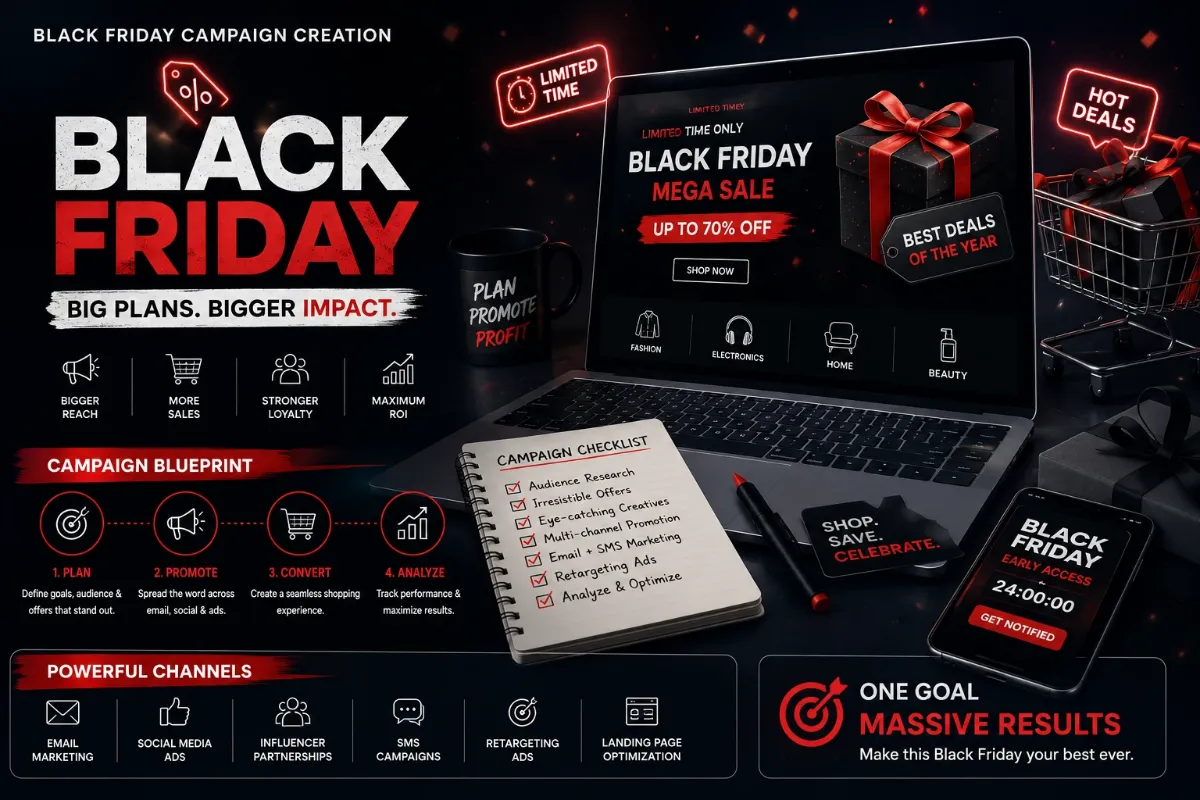
Timing separates the brands that sell out from the ones left with inventory. Work backward from Black Friday and build a runway. A clean 2026 timeline looks like this.
The Four Phases
- Tease (early November): hint that something is coming. Grow your email and SMS lists with a waitlist or early-access signup.
- Warm-up (mid November): share the offer details to subscribers, retarget recent visitors, and build anticipation with content.
- Launch (Black Friday through Cyber Monday): go full throttle across email, paid social, search, and on-site banners.
- Extend (the week after): a final-chance push and a last-minute reminder for the procrastinators who always convert late.
Plan each touchpoint in advance so nothing is improvised during the busiest week of the year. A content calendar generator helps you slot every email, post, and ad into a single view so the team stays aligned.
Build the Email and SMS Engine
Email and SMS are still the highest-ROI channels for Black Friday because you own the audience and the cost per send is tiny. The brands that win send a sequence, not a single blast.
A Proven Email Sequence
- Teaser: "Something big is coming" to your full list.
- Early access: exclusive window for subscribers or VIPs.
- Launch: the deal is live, lead with the hero offer.
- Mid-sale reminder: highlight bestsellers and social proof.
- Last chance: clear urgency, real deadline, no fake countdowns.
Make the Subject Line Earn the Open
Your sequence only works if people open it. Inboxes are brutal on Black Friday, so the subject line carries enormous weight. Test specific numbers, curiosity, and urgency against each other. An email subject line generator gives you a fast batch of options to test instead of agonizing over one line. Pair that with clean segmentation so VIPs, recent buyers, and cold subscribers each get a relevant message.
Run Paid Ads That Capture Demand, Not Just Spend It
Paid social and search amplify a Black Friday campaign, but only if the structure is right. Costs spike in late November as every advertiser floods the auction, so efficiency matters more than at any other time of year.
Structure and Creative
Split your campaigns by intent. Use prospecting to reach cold audiences with your strongest hook, and retargeting to convert the people who already browsed. Refresh your creative often because audiences fatigue fast during a high-frequency window. A clear Google ad structure generator keeps your search campaigns organized so budget flows to the keywords that actually convert, and a Facebook ad copy generator helps you spin up multiple angles to test on social.
Do Not Forget Search Intent
Shoppers researching gifts are typing high-intent queries all through November. Make sure your product and category pages are targeting the terms people actually search. A quick pass with a keyword research tool can surface seasonal terms you are missing before the traffic arrives.
Prepare the Site and Measure What Matters
The best offer fails if the site cannot handle the traffic or the checkout leaks customers. A campaign is only as strong as the experience it sends people into.
The Pre-Launch Checklist
- Test page speed under load. Slow pages quietly kill conversions during peak traffic.
- Streamline checkout. Every extra field costs you sales.
- Make the offer obvious on the homepage, product pages, and cart.
- Confirm tracking and pixels fire correctly so you can measure results.
Know Your Numbers
Decide your success metrics before launch: revenue, new customers, average order value, and return on ad spend. Watch them daily during the sale so you can shift budget toward what is working. If you are unsure whether your site is ready to convert holiday traffic, run a free marketing audit first. It flags the technical and conversion gaps that cost you sales, then returns a prioritized fix list. For brands without the bandwidth to run all of this in-house, it can also make sense to hire a marketer to own the campaign end to end.
Frequently Asked Questions
When should I start planning my Black Friday campaign?
Start at least eight to ten weeks out. List building and warm-up content should be live in early November so your audience is primed before the launch. The actual offer can be finalized later, but the audience and the timeline need a head start. If you want a structured framework to plan from, the DIY marketing plan is a good starting point.
What is the biggest Black Friday mistake brands make?
Treating it as a one-day price drop instead of a multi-week campaign. Without a warm-up phase and a sequenced funnel, you are competing on discount alone against brands that spent weeks building demand. Plan the full arc from tease to extend, and map every touchpoint with a content calendar generator.
How do I keep my margins healthy during a big sale?
Model every offer against your real cost of goods, shipping, and ad spend before you commit, and lean on structures like bundles or gift-with-purchase that protect margin better than a deep flat discount. Then track return on ad spend daily so you can pull back on anything unprofitable. Reading more on the blog can help you refine your approach before the season hits.