
Boost your accounting firm's local SEO with the right business directories and citations. Learn where to list, how to stay consistent, and what drives rankings.
Why Citations Still Matter for Accounting Firms
When a business owner searches for "CPA near me" or "tax accountant in Austin," Google has to decide which firms to trust enough to show first. A big part of that decision rests on citations: mentions of your firm's name, address, and phone number across the web. For accountants, who compete on credibility above almost everything else, consistent citations are one of the quieter but most reliable levers in local search.
What counts as a citation
A citation is any online reference to your firm's core business details. It can be a full directory listing on a CPA platform, a profile on a general directory like Yelp, or even an unstructured mention in a local news article. Structured citations on accounting-specific directories carry extra weight because they signal industry relevance, not just geographic presence.
If you have never audited where your firm currently appears, that is the first gap worth closing. A free marketing audit scores your site across 77 factors, including local visibility signals, and returns a prioritized action plan so you know exactly which citations to fix first.
NAP Consistency: The Foundation Nobody Wants to Talk About
NAP stands for Name, Address, and Phone number. It sounds trivial, but inconsistent NAP data is the single most common reason accounting firms underperform in local search. If one directory lists your firm as "Smith & Co CPAs" with a suite number, another lists "Smith and Company" without it, and a third has an old phone line, Google starts to doubt which version is correct.
How to keep it clean
Pick one canonical version of your firm name, address, and phone number, then use it everywhere with zero variation. Document it in a simple spreadsheet so every team member and every new listing references the same source of truth. When you move offices or change numbers, treat citation updates as part of the move checklist, not an afterthought.
Consistency compounds. Ten clean, matching listings outperform fifty contradictory ones, because trust signals only accumulate when the data agrees with itself.
The Directories Accountants Should Prioritize
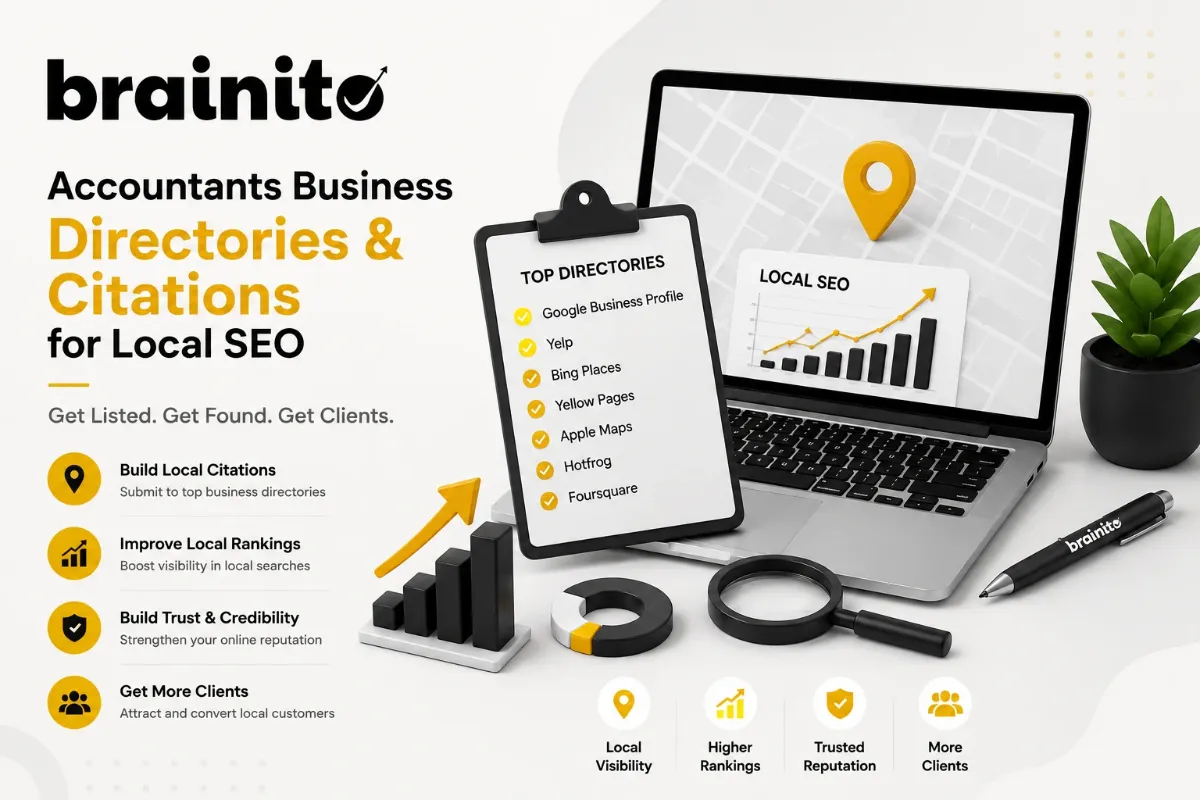
Not every directory deserves your time. Focus on three tiers: your Google Business Profile, major general directories, and accounting-specific platforms. The goal is breadth of trusted sources, not volume for its own sake.
Start with the essentials
Your Google Business Profile is non-negotiable and should be fully completed with categories, hours, services, and photos. From there, claim profiles on Yelp, Bing Places, Apple Business Connect, and Facebook. These general platforms feed data to other engines and carry strong domain authority.
Add accounting-specific platforms
Industry directories tell Google you belong to a specific professional category. Look at CPA directories, tax preparer listings, and finance-focused platforms relevant to your services. Some are free, others charge a listing fee, so weigh each one against the authority and referral traffic it actually delivers. A high-authority paid listing can be worth it; a low-quality paid listing rarely is.
If you want a structured way to decide where to invest, a DIY marketing plan can help you map citations against your local competitors before you spend a dollar.
Auditing Your Existing Listings Before You Build More
Before chasing new citations, fix the ones you already have. Many firms have duplicate or abandoned listings from former office locations, old branding, or third-party data aggregators that scraped outdated information years ago. These stale entries actively work against you.
A quick audit routine
Search your firm name in quotes, then search variations of your name and phone number. Note every listing you find, flag duplicates, and record any that show wrong details. Claim what you can, request removal of true duplicates, and correct the rest. Tools that surface local listing data can speed this up, and our GMB audit tool gives you a fast read on how your Google Business Profile is performing.
This cleanup phase is unglamorous, but it often produces faster ranking gains than adding ten new directories, because you are removing noise that confuses search engines.
Turning Citations Into Real Local Visibility
Citations are a foundation, not a finish line. Once your NAP is consistent and your priority directories are claimed, the firms that pull ahead are the ones that pair citations with reviews, locally relevant content, and a fast, trustworthy website.
Stack reviews on top of citations
Encourage satisfied clients to leave reviews on your Google Business Profile and on the accounting directories where you are listed. Reviews influence both rankings and the decision a prospect makes after they find you. A steady trickle of recent, specific reviews beats a one-time burst.
Support listings with local content
Publish pages and posts that speak to your service area and specialties, such as tax planning for local small businesses or bookkeeping for a particular industry in your city. Internal links from this content reinforce relevance. If you need momentum, our blog content generator and content calendar generator help you ship consistent, on-topic posts. To pressure-test the whole picture, run a free marketing audit and follow the prioritized fixes it returns.
When to Bring in Help
Managing citations is the kind of task that is simple in concept but tedious at scale, especially when you would rather be serving clients. If your firm is expanding to new locations, rebranding, or simply has not touched its listings in years, the workload can stack up quickly.
Choosing between DIY and delegation
If you have a few hours a month and a single location, a disciplined DIY approach works well. If you manage multiple offices or want consistent, ongoing optimization, it may be time to hire a marketer who can own local SEO end to end. You can also compare what hands-on support costs on our pricing page, and browse more local SEO playbooks on the blog.
Whichever path you choose, the principles stay the same: consistent data, trusted directories, and steady reinforcement through reviews and content.
Frequently Asked Questions
How many directory citations does an accounting firm actually need?
There is no magic number. Quality and consistency matter far more than quantity. Start with your Google Business Profile and the major general directories, add a handful of reputable accounting-specific platforms, and make sure every listing has identical NAP data. Ten accurate, authoritative citations outperform fifty inconsistent ones.
Are paid directory listings worth it for accountants?
Sometimes. A paid listing is worth it when the platform has strong domain authority, sends real referral traffic, and is clearly relevant to accounting clients. It is not worth it when the directory is low quality or exists mainly to sell listings. Evaluate each one individually rather than paying for bundles of low-value placements.
How quickly will citations improve my local rankings?
Local SEO is cumulative, so expect weeks to a few months rather than days. Cleaning up inconsistent or duplicate listings often produces the fastest gains because it removes signals that confuse search engines. Pair citation work with reviews and local content to see steadier, longer-lasting improvement.