Learn landing page development the right way in 2026. A practical guide to structure, copy, speed, and testing that turns clicks into customers.
Why Landing Pages Still Decide Your Marketing ROI
You can run brilliant ads and rank for the perfect keyword, but if the page people land on is slow, cluttered, or unclear, that traffic quietly leaks away. Landing page development is the discipline of building a single, focused page whose only job is to move a visitor toward one action: booking a call, downloading a guide, starting a trial, or buying.
Unlike a homepage that tries to serve everyone, a landing page speaks to one audience with one promise. That focus is exactly why it converts better. In 2026, with paid traffic more expensive than ever, the page that receives your clicks is the single biggest lever on your return.
If you are not sure how your current pages measure up, a free marketing audit is the fastest way to see where visitors drop off and what to fix first.
The Anatomy of a High-Converting Landing Page
Great landing pages are not lucky. They follow a repeatable structure that guides the eye and reduces friction at every step.
The hero that earns the scroll
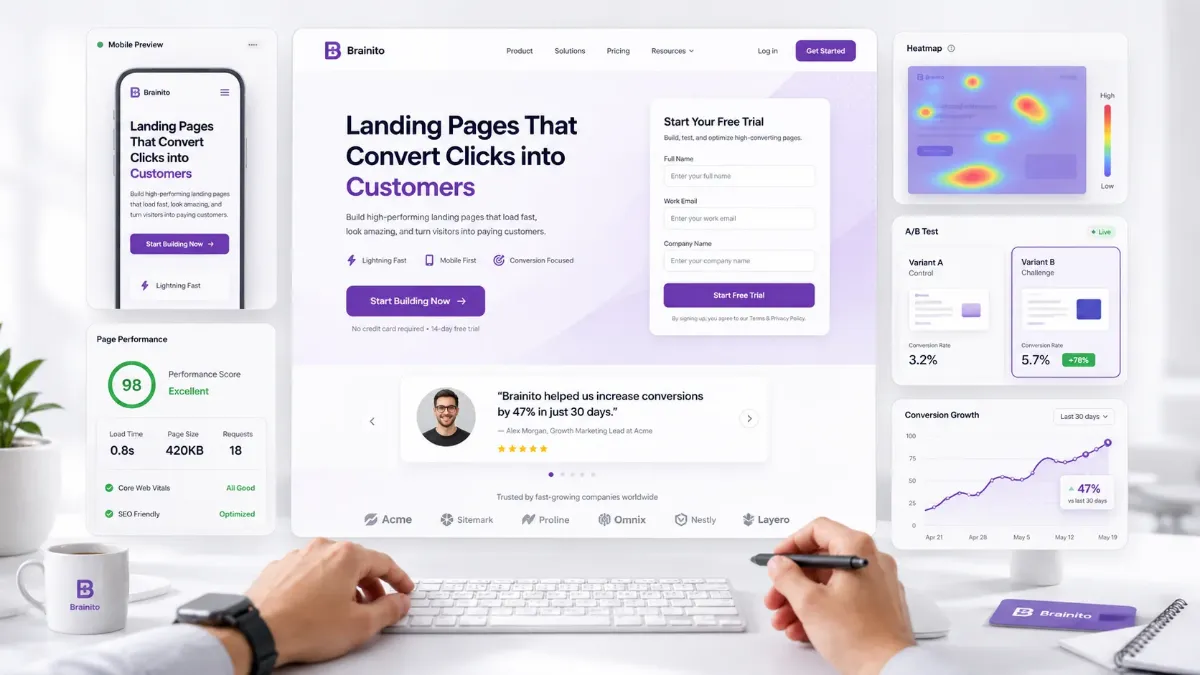
Above the fold you need three things working together: a headline that names the outcome, a subheadline that adds proof or specificity, and a single clear call to action. If a visitor cannot tell what you offer and what to do next within five seconds, the rest of the page barely matters.
Proof, benefits, and objection handling
Below the hero, stack the reasons to believe. Use benefit-led sections instead of feature lists, add testimonials or logos, and answer the doubts that make people hesitate. Every section should either build desire or remove a reason to leave.
One goal, one action
Resist the urge to add navigation menus, five different offers, or links that send people off-page. The most reliable conversion boost is often subtraction. Keep one primary call to action and repeat it as the visitor scrolls.
Choosing Your Build Platform in 2026
The platform you choose shapes how fast you can launch and how easily you can test. There is no single right answer, only the right fit for your team and goals.
- Dedicated builders like Unbounce, Instapage, and Leadpages are made for speed and A/B testing. Ideal if you launch campaigns often and want built-in optimization.
- Website platforms like WordPress, Squarespace, and Wix work well when the page needs to live inside an existing site and share branding.
- Marketing hubs like HubSpot connect your page directly to your CRM and email flows, which matters if lead routing is complex.
- Custom-coded pages give total control over speed and design but demand developer time.
Whatever you pick, the fundamentals stay the same: clear message, fast load, frictionless form. If you would rather have a specialist handle the build and strategy, you can hire a vetted marketer to do it right the first time.
A Practical Development Workflow That Ships Fast
A messy process produces a mediocre page. Here is a lean workflow you can reuse for every campaign.
1. Define the goal and audience
Write down the single action you want and the exact person you are writing to. This anchors every design and copy decision that follows.
2. Draft the flow before the design
Outline sections in order: hero, proof, benefits, objections, call to action. Getting the sequence right on paper saves days of redesign later.
3. Collect copy and assets
Strong words beat pretty layouts. Gather testimonials, real numbers, and product screenshots first. Need help planning the message? A content brief generator keeps your copy on-target.
4. Build, wire up tracking, and connect the domain
Assemble the page, then install analytics and conversion tracking (such as Google Analytics and your ad pixels) before launch. Connect the domain and confirm the form actually delivers leads to your inbox or CRM.
5. Review, refine, deploy
Run one focused feedback round, fix the friction points, then publish. Building this as part of a broader DIY marketing plan keeps the page connected to your funnel instead of standing alone.
Speed, Mobile, and Technical Details That Move the Needle
Most conversion problems are invisible in a design mockup and only appear in the real world. These technical basics quietly protect your results.
Load speed: Every extra second of load time costs conversions. Compress images, limit heavy scripts, and test on a real phone, not just your desktop.
Mobile first: The majority of ad traffic is mobile. Design the small screen first, keep forms short, and make buttons thumb-friendly.
Message match: The headline on your page should echo the ad or search term that brought the visitor. A mismatch feels like a broken promise and spikes your bounce rate. Pairing tight ad copy with a matching page, for example using a Google ad structure generator, keeps the whole journey coherent.
Trust signals: SSL, clear privacy language, and visible contact details reassure first-time visitors that it is safe to convert.
Testing and Optimizing After Launch
Publishing the page is the starting line, not the finish. The pages that win are the ones that get refined with data.
Start by watching where people drop off. Heatmaps and analytics show whether visitors bounce at the hero, stall before the form, or never reach your call to action. Then test one element at a time: headline, button copy, form length, or the primary image. Changing everything at once tells you nothing about what actually worked.
Small, consistent gains compound. Lifting conversion from 2 percent to 3 percent means 50 percent more leads from the same traffic and budget. To find the highest-impact fixes across your whole site, run a free marketing audit that scores your presence across 77 factors and hands back a prioritized action plan, so you optimize the pages that move revenue first. You can also browse more playbooks on the Brainito blog as you iterate.
Frequently Asked Questions
How much does landing page development cost in 2026?
It varies widely. A do-it-yourself page on a builder can cost only the monthly subscription, while a professionally strategized and built page typically starts around $1,000 and rises with complexity, custom design, and integrations. The real question is return: a page that converts pays for itself quickly. See the pricing options for guidance.
How long does it take to build a landing page?
With copy and assets ready, a focused single-goal page can be built and launched in a few days to two weeks. Delays almost always come from missing content or unclear goals, not the build itself, which is why defining the goal and gathering copy up front matters so much.
Do I need a landing page if I already have a website?
Yes. A homepage serves many audiences and many goals, which dilutes conversion. A dedicated landing page matched to a specific ad or campaign consistently outperforms sending that traffic to your homepage. If you want expert help, you can hire a marketer to build and optimize it.