Getting traffic but no leads? Learn the real CRO reasons visitors do not convert and the fixes for offers, forms, speed, trust, and messaging.
Traffic Is a Vanity Metric Until It Converts
You are doing the hard part. People are landing on your site from search, ads, and social. Yet your inbox is quiet and your pipeline looks the same as it did last quarter. Traffic without leads is one of the most frustrating problems in marketing because it feels like success and pays like failure.
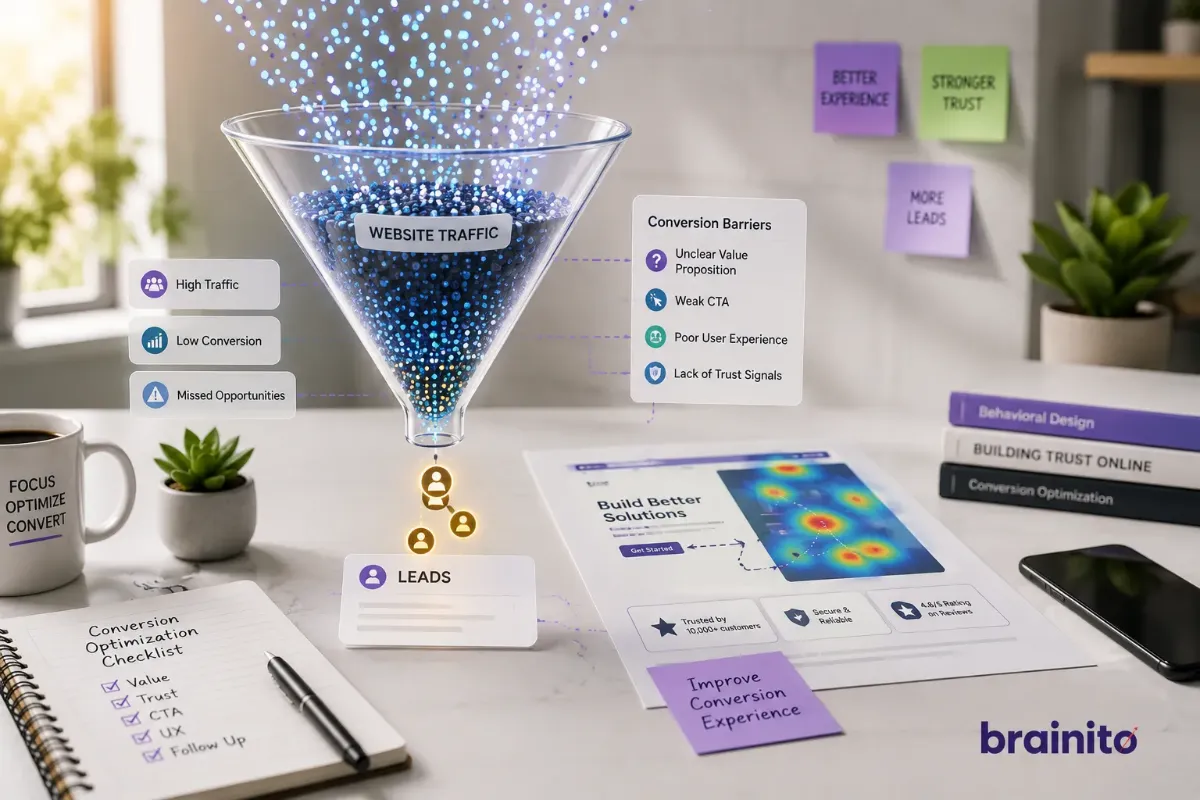
The truth is that traffic is only a vanity metric until it converts. A site can pull thousands of monthly visitors and still generate almost nothing if the path from "interested stranger" to "qualified lead" is broken. Conversion rate optimization (CRO) is the discipline of fixing that path. In this guide we will walk through the most common reasons traffic stalls and the practical fixes for each one.
If you would rather skip the guesswork, you can run a free marketing audit that scores your website across 77 factors and returns a prioritized action plan. It is the fastest way to see exactly where your visitors are dropping off.
Reason 1: Your Offer Is Weak or Unclear
Most "traffic but no leads" problems are actually offer problems. Visitors do not convert because you are asking them to take a step that feels too big, too vague, or too risky for the value they get in return.
Look at your primary call to action. "Contact us" and "Request a quote" demand high commitment and give nothing back. Compare that to a specific, low-friction offer: a free teardown of their current strategy, a checklist, a calculator, or a same-day callback. The job of your offer is to make saying yes feel easy and obviously worth it.
How to strengthen your offer
- Lower the commitment. Replace "Buy now" or "Book a call" with a smaller first step when traffic is cold.
- Make the value concrete. Tell people exactly what they get and how long it takes.
- Remove the risk. Add guarantees, "no credit card," or "no obligation" language.
If you are not sure what offer your audience actually wants, a DIY marketing plan can help you map offers to each stage of your funnel before you spend another dollar on traffic.
Reason 2: Messaging Does Not Match Visitor Intent
People arrive on your page with a specific question in mind. If your headline talks about your company instead of their problem, they bounce. This mismatch between what visitors searched for and what your page says is one of the quietest killers of conversion.
Read your above-the-fold copy as a first-time visitor. Within five seconds, can someone tell what you do, who it is for, and why it matters to them? If the answer is "not really," your messaging needs work. Clarity beats cleverness every time.
Strong messaging follows a simple pattern: name the problem your visitor has, show that you understand it, then position your product as the obvious solution. Use the words your customers actually use, not internal jargon. And make sure each landing page matches the intent of the channel that sent the visitor. Ad traffic, blog traffic, and homepage traffic all expect different things.
Reason 3: Friction in Forms and the Conversion Path
Every extra form field is a tax on conversion. If you ask for ten pieces of information just to download a guide, most people quit. Forms should request the minimum you need to follow up, and nothing more.
Audit your forms for friction
- Cut the field count. Name and email are often enough to start. Qualify later.
- Make labels clear. Avoid confusing field names and surprise required fields.
- Show progress on long forms. Multi-step forms with a progress bar convert better than one intimidating wall.
- Fix mobile forms. Use correct input types so phone keyboards adapt and tap targets are large.
Beyond forms, look at the whole path. How many clicks from landing to lead? Every unnecessary page, redirect, or distraction leaks visitors. Aim for the shortest honest route from interest to action.
Reason 4: Slow Pages and Poor Mobile Experience
Speed is conversion. When a page takes more than a few seconds to load, a large share of visitors leave before they ever see your offer. The damage is worst on mobile, where most traffic now lives and where connections are less forgiving. If you are paying for that traffic, slow pages are quietly burning your budget.
Common culprits include oversized images, bloated scripts, and heavy third-party tools. Compress images, lazy-load anything below the fold, and remove plugins you do not truly need. Then test your most important pages on a real phone, not just your desktop. Buttons that are easy to tap, text that is easy to read, and forms that work with one thumb make a measurable difference.
Mobile optimization is no longer optional. A site that looks great on a laptop but fights the visitor on a phone will leak leads every single day.
Reason 5: No Trust, No Proof, No Reason to Believe
Even a visitor who likes your offer will hesitate if nothing on the page tells them you can be trusted. Trust signals close the gap between interest and action.
Add real proof near your calls to action: customer testimonials with names and faces, recognizable client logos, case study results with actual numbers, review scores, and security or guarantee badges. Specific proof beats generic praise. "Increased qualified leads by 38% in 90 days" is far more persuasive than "great service."
Also pay attention to the basics that signal legitimacy: a professional design, clear contact details, a privacy policy, and consistent branding. These small things quietly reassure visitors that they are dealing with a real, credible business. When you are ready to put a senior set of eyes on the whole experience, you can hire a marketer to pressure-test your funnel end to end.
Turning Diagnosis Into an Action Plan
Fixing a leaky funnel is not about guessing which lever to pull. It is about finding the single biggest drop-off point and fixing that first. Start by mapping where visitors actually fall away: which pages get traffic but no conversions, where forms get abandoned, and which devices underperform.
The fastest way to get that map is to run a free marketing audit, which scores your site across 77 factors covering speed, messaging, trust, and conversion design, then hands you a prioritized list of what to fix in order. From there you can build out the content and offers that pull qualified visitors deeper. A content brief generator helps you create pages that match search intent, and a structured DIY marketing plan keeps every change tied to a measurable goal.
You worked hard to earn your traffic. Make it count. Tighten the offer, sharpen the message, strip out friction, speed up your pages, and prove you are worth trusting. Do that, and the same traffic you have today starts producing the leads you have been missing.
Frequently Asked Questions
Why is my website getting traffic but no leads?
Usually it comes down to one or more of five things: a weak or unclear offer, messaging that does not match what visitors came for, too much friction in forms and the conversion path, slow or poorly optimized mobile pages, or a lack of trust signals. The fastest way to find your specific bottleneck is to run a free marketing audit that scores your site and tells you what to fix first.
How do I improve my website conversion rate?
Focus on one change at a time so you can measure impact. Strengthen your primary offer, cut form fields to the essentials, speed up your pages, and add real proof like testimonials and case study numbers near your calls to action. Pair these fixes with content that matches visitor intent using a content brief generator, and track results so you keep what works.
Should I hire help or fix conversions myself?
Both paths work. If you have time, a DIY marketing plan gives you a structured way to test fixes yourself. If you want speed and senior expertise, you can hire a marketer to audit your funnel and implement the highest-impact changes for you.