
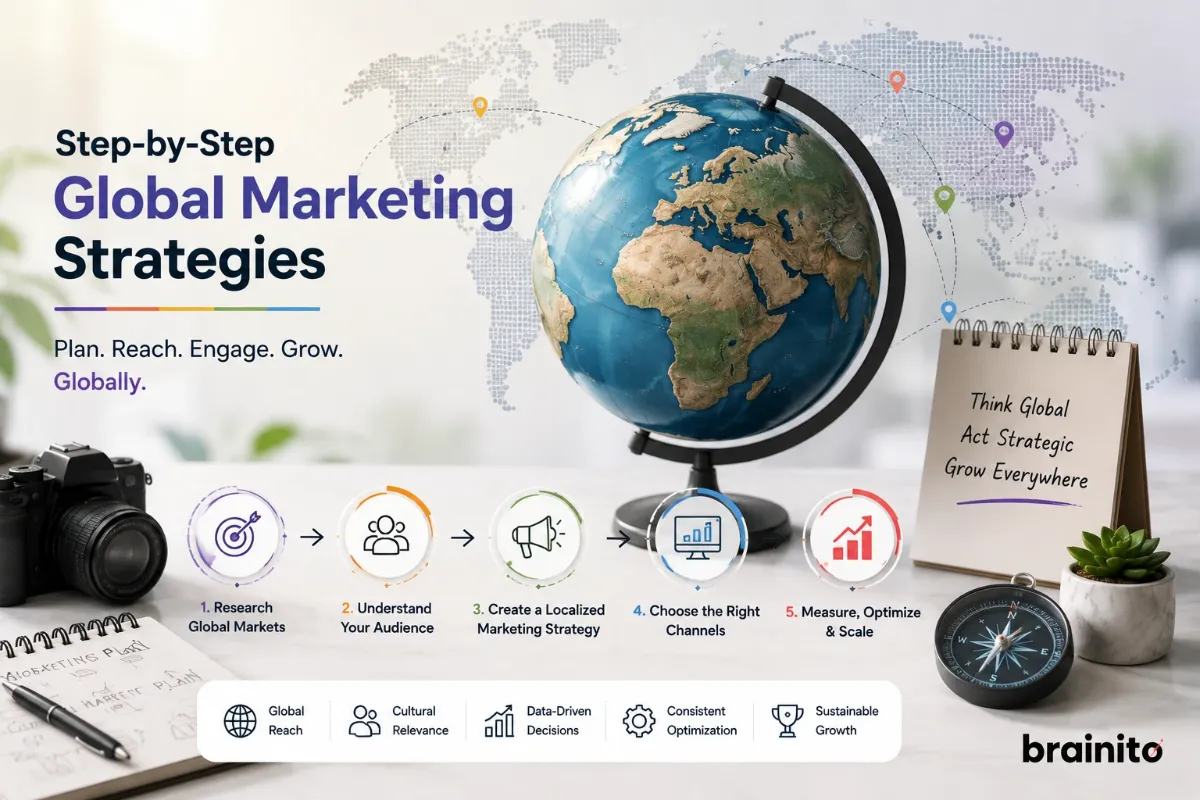
Build a global marketing strategy step by step: market research, localization, channel selection, and budget. A practical 2026 framework for entering new markets.
Why Global Marketing Is No Longer Just for Giants
For a long time, expanding into international markets felt like a privilege reserved for household-name brands with deep pockets. That story is outdated. Cloud tools, cross-border payment rails, and ad platforms that reach almost every country mean a lean team can sell into a new market within weeks, not years.
What separates a successful expansion from an expensive misfire is rarely the size of the budget. It is the sequence. Skipping research to chase quick wins, or copy-pasting your home-market campaign into a country that thinks and shops differently, is where money disappears. This guide walks through a clear, ordered framework for building a global marketing strategy that holds up in 2026.
Before you point your strategy outward, it helps to know where your current marketing actually stands. Running a free marketing audit gives you a baseline across 77 ranking and conversion factors so you expand from strength, not guesswork.
Step 1: Validate Demand With Real Market Research
The first question is not "how do we launch?" but "does anyone in this market actually want what we sell?" Enthusiasm is not evidence. You need signals that demand exists at a price you can serve profitably.
Where to look for proof
- Search volume: Use a keyword research tool to see how often people in a target country search for your category, and in which language.
- Competitor presence: If local players already advertise heavily, demand is usually real. A total vacuum can mean opportunity, or it can mean nobody buys this here.
- Marketplace data: Reviews, ratings, and bestseller lists reveal what customers value and complain about.
Pick two or three candidate markets and score them on demand, competition, ease of entry, and margin. Resist the urge to enter five countries at once. Depth beats breadth in the early stages.
Step 2: Localize, Don't Just Translate
Translation swaps words. Localization adapts meaning, tone, imagery, pricing, and even product features so the experience feels native. A literal translation of a clever tagline often lands as awkward or, worse, offensive.
Localization touches more than copy. Date formats, currency, units, payment methods, color associations, and customer-service hours all shape trust. McDonald's is the classic example: the brand is globally consistent, yet the menu shifts country by country to match local taste. Your job is the same balancing act, a recognizable brand with locally relevant details.
Build a simple localization checklist for each market covering language, currency, legal disclaimers, and cultural sensitivities. Have a native speaker review everything customer-facing before launch. Machine translation is a starting draft, never the final word.
Step 3: Map the Customer Journey for Each Market
Buyers in different countries move through awareness, consideration, and decision at different speeds and through different channels. In one market, customers research extensively on search before buying. In another, social proof and messaging apps drive most decisions.
Map the funnel market by market. What triggers awareness? What objections surface during consideration? What closes the deal? Answering these shapes where you spend and what you say. A DIY marketing plan can help you structure this thinking into stages with owners, channels, and goals rather than a vague wish list.
Document the journey in plain language so your whole team shares the same mental model. This prevents the common trap of optimizing one channel while the real bottleneck sits somewhere else entirely.
Step 4: Choose the Right Channels, Not Every Channel
Channel preference varies dramatically by region. The platform that dominates at home may be a minor player abroad, while a local network you have never used owns the market. Trying to be everywhere spreads a modest budget too thin to make an impact anywhere.
A practical channel shortlist
- Search ads capture existing demand. Strong structure matters, so build campaigns deliberately with a Google ad structure generator.
- Paid social builds awareness and retargets. Tight creative wins here, and a Facebook ad copy generator speeds up local variations.
- Content and SEO compound over time and build credibility in a new market.
- Local partnerships and influencers lend trust you cannot buy quickly as an outsider.
Start with one or two channels per market, prove the unit economics, then expand. Discipline early protects you from burning budget on channels that look busy but do not convert.
Step 5: Build, Test, and Improve Locally
Launch is the beginning, not the finish line. Stand up localized landing pages, run small test campaigns, and watch the metrics that matter: cost per acquisition, conversion rate, and retention. Treat the first weeks as paid research.
Keep your publishing consistent so momentum builds. A content calendar generator helps you plan localized posts, emails, and campaigns ahead of time instead of scrambling. Consistency signals commitment to a new audience and to the search engines indexing your content.
Set a regular review rhythm. What is working, what is leaking, and what assumption from Step 1 turned out to be wrong? Markets shift, so build a contingency plan for the channel or message that underperforms. The teams that win globally are the ones that adapt fastest, not the ones that planned most perfectly. If you want an outside read on what to fix first, a free marketing audit returns a prioritized action plan you can hand straight to your team.
Frequently Asked Questions
How many markets should I enter at once?
Start with one or two. Concentrating budget and attention lets you learn the local funnel, prove profitability, and build a playbook you can repeat. Spreading thin across many countries usually means weak results everywhere and no clear lesson to carry forward.
Is translation enough to go global?
No. Translation handles words, but localization adapts pricing, imagery, payment methods, tone, and cultural context so the experience feels native. Have a local speaker review anything customer-facing, and treat machine translation as a first draft only.
How do I know which marketing channels to use abroad?
Look at where your target customers already spend time and search, not where you are comfortable. Validate with keyword and competitor research, then pick one or two channels per market to test before scaling. If you are unsure where to begin, a marketing expert or a structured marketing plan can point you to the highest-leverage starting point.